
 |
Our treks | Expeditions | Contact us | About us | Old photos & Diaries |

|
Lhasa & Everest Base Camp10 day Tibet overland tour by 4 wheel drive, from Lhasa to Everest Base Camp to Kathmandu **Well done on reaching this page. While our partners still run Tibet tours we no longer advertize them.** The roof of the world is a unforgettable land of curious nomads, mysterious gompas and breathtakingly vast panoramas. In Lhasa, long the forbidden city, experience the timeless and most holy Jokhang temple and see the legendary eighth-wonder Potala Palace and more. We spend 4 nights in Lhasa, staying in the old city, so plenty of time for acclimatization and sightseeing. Leaving Lhasa in our Toyota Landcruiser 4 wheel drives, we drive, with stops along the way, to Rongbuk. Everest Base Camp is a highlight, where the sheer grandeur of Everest's north face has to be seen to be believed. Inspiring landscapes and mountain views combined with its rich Buddhist history and culture, and contrasting with the recent development, make visiting Tibet a truly unforgettable experience. Outline Itinerary
|
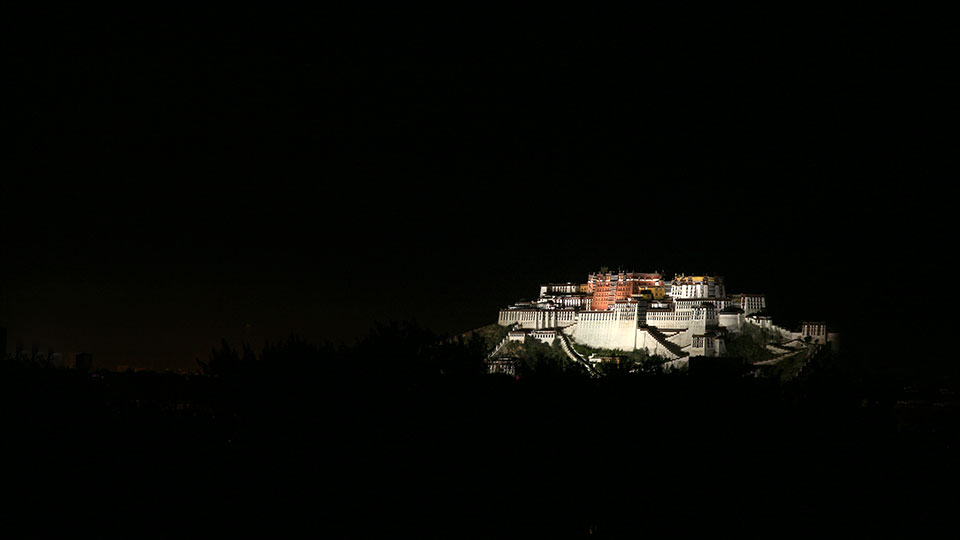
The magnificent Potala Palace
|

|
Will you see Everest?This is the question that I get asked the most, and the answer is yes. Many people are aware that the monsoon buffets up against the Himalaya from approximately the middle of June to the middle or end of September. In fact for the month before the monsoon hits, and for the month after it has officially receded, the weather patterns are similar, so the following applies to virtually the whole time that we run trips. The monsoon washes over Tibet sometimes bringing brief showers of rain and lots of cloud but mostly the main Himalayan chain stops the real monsoon from reaching Tibet. Tibet is mostly fine for the whole year and it is very rare for it to be covered in thick cloud, rather big, fluffy clouds often form in the afternoon. Sometimes these obscure views but often they don't, merely add to the whole panorama. On the trip there are four opportunities to see Everest. First when driving off the main road you cross the Pang La where there is a magnificent Himalayan panorama including a stunning view of Everest. Normally you cross this in the afternoon so there is only a reasonable chance of catching the view. Then you stay the night at Rongbuk and the next morning walk or take a horse cart up to Everest Base Camp, which is about 8 kilometres away. Mostly it is fine in the morning so you have a very good chance of seeing Everest from here. Then after Base Camp you drive over the Pang La again to Tingri, and have another chance of seeing while crossing the pass. Then at Tingri as you leave the next morning you can see Everest and Cho Oyu from the road, although they are not as impressive from this far away. So there are many opportunities and you will have to be very unlucky not to see it, no matter what month you visit. ConditionsThis is an adventurous holiday. You are heading to high altitude, and this fact should not be taken lightly. Driving across Tibet is rough and adventurous, although we use good, comfortable vehicles. In the cities we stay in well located three-star hotels, but in the towns and villages the hotels are rough and basic. In some places there are good restaurants, and others the choices are fairly basic but usually your guide will help you order. There is no trekking on this tour, but there is plenty of walking. You should be moderately fit, at least. We have tried our best to make this a comprehensive, comfortable and well organized tour. There are no corners cut in doing this but it is definitely not a five star tour. Winter toursAir China is running flights between Kathmandu and Lhasa in winter. Traveling in Tibet in winter is pleasant because there are few other tourists. Most definitely it is much colder but you are in heated vehicles and hotels. During the day you need a good jacket, preferably a down jacket to keep warm but with the sun shining it is normally pleasant enough. The evenings are extremely cold, requiring hat and gloves and some sort of insulated pants. Please ask about our winter departures. Detailed itineraryDay 1 - Fly Kathmandu (1400m) - Lhasa (3660m)Morning transfer to the airport for the hour long flight to Tibet. What a spectacular flight! You cross the main Himalayan range with stunning views of Kanchenjunga. After landing at Gonggar Airport and meeting our Tibetan guide, it is a further 1.5 hour drive to Lhasa. Even if you feel good it's advisable take it easy for the remainder of the day due to Lhasa's altitude and be sure to drink plenty of fluids. Day 2 - in LhasaToday will be spent visiting several of Lhasa's many monasteries. Over two days you normally tour the Potala, Sera Monastery, Drepung Monastery, Norbulingka (the Dalai Lama's summer palace) and the incredible Johkang Gompa. Sera Monastery is one of the best preserved monasteries in Tibet. Within it's white-washed walls and golden roofs, several hundred monks live and study. The Jokhang is the most sacred shrines in Tibet and there is always a procession of devout Tibetans through the complex. Surrounding the Jokhang is the Barkor - a maze of narrow cobbled streets which is the central market of Lhasa, as we stay close by. Day 3 - in LhasaThe Potala Palace which dominates the city of Lhasa. A spectacular building, it contains the private quarters of the Dalai Lama as well as numerous grand state rooms and many important chapels. There has been a palace on this site since the 5th or 6th century, but the present palace was constructed in the 17th century. A visit to the Drepung Monastery completes a truly awe-inspiring day. Founded in the 14th century, this monastery was once the largest in the world, with a population of around 10,000 monks. These days that figure is down to several hundred, but there is still much here of interest as it was left relatively unscathed during the Cultural Revolution. Day 4 - in LhasaThis is a day at leisure in which you are free to explore further, revisit a favourite monastery or simply sit in a café overlooking the Barkor and watch the pilgrims as they circumambulate the Jokhang. There is also the option of an additional tour to places such as Ganden Monastery and Tsurphu Monastery, for extra costs. Day 5 - drive Lhasa - Gyantse (3950m) 261 kmTravelling by Landcruiser along the Friendship Highway we cross the Khamba La (4794m) from which there are stunning views across the waters of Yamdrok-tso (lake) to the snowy summit of Nazin Kang Sa 7252m. We continue westwards over another high pass, the Karo La 5045m, where we are treated to the spectacular sight of a huge glacier tumbling down to within a few hundred metres of the road. After passing through stunning valleys and Tibetan villages you arrive in the town of Gyantse. Day 6 - drive Gyantse - Shigatse (3900m) 90kmBefore leaving Gyantse we have time this morning to visit the Gyantse Dzong and Gyantse Kumbum. The Dzong is a fort dating from the 14th century from which there are amazing views of both Gyantse itself and the surrounding Nyang Chu Valley. The Kumbum is a large gold-domed stupa and its many small chapels house an impressive array of Tibetan Buddhist murals. We then continue on to Shigatse, a short drive of only 90kms, arriving in time for lunch. Shigatse is the second largest city in Tibet and after exploring the local market we will make a detailed visit to the Tashilhunpo Monastery. This monastery is one of the largest functioning monasteries in Tibet and there is much to explore within its high surrounding walls. Day 7 - drive Shigatse - Shegar (New Tingri: ~4050m) 244kmToday we continue along the Friendship Highway, across the barren yet spectacular landscape of Tibet. Beyond the small town of Lhatse we cross the highest pass on our journey, the Gyamtso La, 5220m. From here we descend, passing lonely monasteries and the camps of nomadic herders, en route to the settlement of Shegar. Day 8 - drive Shegar - Rongbuk (5000m) 68kmShortly after leaving Shegar, we turn off the Friendship Highway and head south over the Pang La 5150m towards the main Himalayan range. The view from the top is incredible with uninterrupted views stretching from Makalu to Shishapangma. Below the pass, Everest initially is hidden from view, but as we turn the corner into the Rongbuk Valley it reappears, more impressive than ever. We normally overnight at the Gompa Guest House. Day 9 - drive Rongbuk - Zhangmu (2300m) 246kmThis morning we have the opportunity to see Everest Base Camp, 5150m. The base camp itself is dry and barren, but the views of Everest more than compensate for this. It is a truly awe-inspiring place with the sheer north face of the highest mountain in the world towering above us. No vehicles tour vehicles, except for Everest expeditions, are allowed beyond Rongbuk so you can walk the 8kms or take a horse cart that will cost $3-5 per person. After lunch, we return to the Friendship Highway and drive to Zhangmu, crossing two high passes, the Lalung La 5124m and the Shung La 5200m. Once more we are rewarded with magnificent views of the surrounding peaks of Shishapangma, Cho Oyu, Menlungtse and Gauri Shankar. We descend from the arid Tibetan Plateau to Zhangmu on the Nepalese border. After Tibet, it appears an incredibly lush and green town. We overnight here. Day 10 - drive Zhangmu - Kodari - Kathmandu (1400m) 123kmFrom Zhangmu we drive a few kilometres to the Friendship Bridge which spans the Bhote Kosi River and marks the Chinese - Nepalese border. We say goodbye to our Tibetan guide and driver and walk to Nepalese Immigration Control in Kodari where we will be met by our Nepalese staff. After completing the re-entry formalities we continue the drive to Kathmandu which, depending on road and weather conditions, should take about 5 hours. Occasionally the road between the Nepali and Chinese border posts becomes impassable; this is often the case in late July and August. In that case your luggage will be carried by porters for what is sometimes a 4km walk. Our border staff will arrange everything, but you will have to pay extra. We drop you in Thamel, the tourist center and you are free to choose a hotel; or we can arrange. You are free to leave Kathmandu tomorrow, alternatively why not stay a day or two more. We hope you had a great trip! 
jdesign -- all rights reserved -- frozen in time July 2013 |