
 |
Our treks | Expeditions | Contact us | About us | Old photos & Diaries |
|
Kanchenjunga MagicThe Three Peaks Expedition of October/November 1999 by Dana Alford PreludeThe thought of turning 50 and never having been to Nepal, of never seeing the Himalaya, reminded me that one could die and never do those things most dreamed of, that a whole life could pass - by days and years and decades - and somehow never get around to something personally important or dreamed of, always waiting for another, more convenient, time. I started searching on the web for treks in Nepal a year before I went. The group I choose, Himalaya Trekking (now Project Himalaya), is the excursions of one Jamie McGuinness, a 34 year old "Kiwi", who's spent the last 12 years in Nepal and authored 2 trekking guides. Himalaya Trekking (Project Himalaya) is run through the Nepalese outfitter Explore Himalaya, owned by Suman Pandey. Suman, whose father was a Nepalese general, is well connected throughout the government and his operation runs many treks and full blown expeditions in Nepal and Tibet. 
|

|
Introduction to NepalNepal is an east-west rectangle in between the 2 mega-powers of the sub-continent, India and China. It has troublesome Pakistan to the west and disputed Kashmir. It is land-locked and resource poor, relying on these monsters for supplies and access to the world. It is 56,000 square miles, the size of Maryland, stretching 550 miles east to west, along the very crest of the Himalaya. These are the world's highest peaks, formed by the collision of the Indian sub-continent moving north and Asia moving south. Once under sea level, shells are found at its heights. Nepal has 21 million people, half under the age of 21, growing at 2% annually. The Kathmandu valley has a million. Tribal groups include Gurung, Limbu, Magar, Newar, Sherpa, Tamang, and Tharu, and others. The Sherpa came originally from Tibet over the Himalaya to the north. Major cast groups are the Brahmans and Chhetris and many Indians live in Nepal. It is officially 86% Hindu, 8% Buddhist, 3% Islamic, but in reality it's probably more like 25% Buddhist. Also, Buddhism and Hinduism blend and blur here. Close to a billion people revere the Himalaya as sacred and many, particularly Indians, annually visit religious shrines here. Below the peaks to the south is the low land Terai which used host malarial swamps, the diseases of which kept the British from bringing the kingdom of Nepal into its empire. That Nepal has never been subject to any other country is a source of deep pride. In fact, the kingdom was closed off to the outside world prior to 1949. That year, when China took over Tibet and the Sherpas' salt and goods trade between Tibet and Nepal was closed down, Nepal opened its doors to foreigners and mountaineers and Sherpas quickly moved into guiding. Thursday, October 7th6:45AM departure for Denver International Airport. 4 hours in LAX International terminal. 2:40pm Thai Air to Bangkok. Little sleep. Several movies. Food, drink and service on Thai is plentiful and commendable. The stewardesses wear tight kimono-type gowns that look improbable in an aircraft aisle, but you get used to it. Friday, October 8th11 hours LAX to Tokyo. 45 minutes' walk in Narito Airport and 6+ hours to Bangkok. Am solicited to buy sex before I can walk over the freeway-crossing skyway to check into the Amari Airport Hotel. Decline. Shower. In bed at 1:05 am. Wake up call set for 7:30. Did I gain a day? Saturday, October 9thAutomated computer wake up call. Another shower. A rice dish for breakfast in the airport across the skyway. Airport exit tax is 500 Thai baht at 35 baht per dollar. On the plane I meet a jovial 28 year old Nepali software manager working in Malaysia en route home to go on an annual trek with friends. His home town is outside of Pokhara, near the Annapurna region and he made me feel welcome to Nepal. There is a large, very severe, snowy peak rising above the clouds to the east. I'm certain it must be the Kanchenjunga massive, where I'm going. It has a huge cloud wisp flying from its tallest peak, sticking way above the cloud bank, out by itself. It is my first view of the Himalaya. I'm absolutely thrilled. While waiting in the line for a visa in Kathmandu, I chat with a young American fellow running motorcycle tours through the middle "hills" of Nepal. After gathering myself together, I exit the airport and walk between fenced off crowds, starring, shouting, some with signs. I'm looking for someone or something and see an "Explore Himalaya" sign. I am met by a very affable, good looking young fellow named Jeetendra. He says to wait while he finds another group member, Dave Haun, who's apparently been on the same flights with me since LA. We are directed toward a waiting car and hustled by bag boys. They are scamming foreigners, saying their tips to carry our bags are too small, knowing full well these jet-lagged tourists haven't the faintest idea of currency values. We learn a lesson and, as Jamie is to say later, consider the few lost rupees as "foreign aid". En route to the Dynasty Hotel we comment as how the teaming streets of Kathmandu are like a fantastic movie, not reality at all. There are 20 million people in Nepal, a country about the size of Maryland, and a lot of them live here. The Dynasty is an oasis: down a quiet dirt back street, away from the noisy, chaotic main drags, uniformed guard, marble floors, cordial front desk, nicely appointed, air conditioner, TV, CNN, etc. I later meet up with June Craven, a friend from Denver, who has just come to Nepal for a 2 month visit starting 3 days before me. She bubbles on about her adventures so far and says we should go tomorrow to Pashupatinath, a religious site, with her friend Marsha, a neighbor from Denver who is teaching university psychology in Kathmandu. June and I get Dave and go out exploring Thamel, the tourist-oriented area of the city we're in. Somehow we find the new Nepali friend she'd just met a day or two before. The fellow is opening his new restaurant in the next day or two and is so genuinely delighted to see us he puts up a table for us on the roof, giving us the bird's eye panoramic view of the city at dusk. The exposure of balancing on roof-top beams and pipes above the city to get the best view is more exciting than the sunset. Exceedingly jet lagged, we have Indian food with the group. Dave and I are given into the care of a mountaineering/guide acquaintance of Jamie's also staying at the Dynasty and he leads us back through the teaming, twisted streets of Thamel, saying he really respects Jamie's reputation, but has never actually been in the mountains with him. |


Dave E Haun 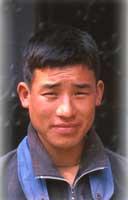
Ang Dami Kitchen hand 
Pasang Our climbing guide |
Mountain flightSunday, October 10thI've booked a fly-by of Everest the day after I arrive, not wanting to miss the chance to see the biggest mass of rock in the world. Jeetendra said he'd to pick me up at 6am to go to airport. I'm awake early, get up around 5 and take a short walk around the waking Kathmandu (some gruesome, but shop owners cleaning the streets from the previous day's litter) . The car shows up at 6:30. The 8:30 plane flight takes off at 10 due to heavy, pea soup ground fog and haze that shrouds the valley. Peaking from the door and windows of the departure lounge I see the haze lifting and, through a gap in the clouds, a snow capped peak. I can see the Himalaya. A jitney bus takes us out our to the Buddha Air plane on the tarmac: a pressurized, twin engine prop, 18 passenger Beech, with single seats on a side and narrow center isle. They give you cotton for your ears, candy for pressurization, and a 2 panel fold-out silhouette drawing of the range to clip on the seat in front to trace your flight path along the range as we go: from Langtang Lirung (7,234m; 23,734ft.) in the Langtang region, over the Phurbichyachu Himal, the Rolwaling Himal, and through the Khumbu Himal, the Everest area. Kathmandu is roughly 50 flight miles from the crest of the range and we fly almost 100 miles west to east along the range and then retrace our flight back along the ridge and then back to Kathmandu. It is an absolutely breathtaking, excruciatingly exciting trip. The lower rolling hills and lush, terraced valleys give way to increasingly more severe territory, crescendoing - literally - at the crest of the world. I am awestruck. As we make our way east along the south side of the range, this fascinating, wonderful part of the planet unfolds underneath us. We can see to the north into the rolling brown mountains of Tibet, much less severe and immensely vast. And then there is Everest. It is unmistakable and utterly majestic. I believe I can even make out the Hilary Step on the much traveled south east ridge. For me, it is a wonderful, awe-filled, "life time" moment. Saying it is breathtaking or majestic is a gross understatement. For me it is quite ineffable. The plane goes along the range east past Everest, almost to Makalu, and then turns around and retraces its flight going west along the range so the other side of the plane gets the "in your face" view. When you're on the "away" side from the high peaks, the stewardess lets you go up one by one to the cockpit to take in the panorama. At times you're looking straight down on some of the world's most incredible peaks and the valleys that drop away from them. The flight takes almost exactly an hour and we probably get to around 24,000 or more feet and maybe within 5 miles of the summit of Everest. That afternoon Jamie gives Dave and me a gear check, making 3 piles each: leave in Kathmandu, trekking gear, and high mountain gear. Then Dave and I take a cab to Pashupatinath to meet June and Marsha. We don't know exactly what it is and so feel a bit lost when we're dropped off at an intersection of the road. A pedestrian way with vendors and teaming urban life lines the way down a hill toward a more built up area and we run into June and Martha along the way in the shops and chaos. From Jamie McGuinness' Trekking In The Everest Region: "Beside the sacred Bagmati River, Pashupatinath is one of the most revered Hindu temples on the Indian subcontinent. Entry to the main temple is barred to non-Hindus but there are many other shrines in this large religious complex. Dedicated to Shiva, the destroyer and creator – stone lingam fertility symbols are everywhere. Cremations take place on the banks of the river, providing a morbid attraction." Lower casts are cremated down stream, upper casts up stream. When the pyre on the stone platform is burned out it is swept into the river and the next one takes its place. There are saddhus, saffron-robed holy men, offering to perform various feats, or photo-posing for rupees. Smiles are extra rupees. Monkeys are all over the place, stealing food as they can. Smoke from the cremations wafts in and out. Mourners grieve. The dying within the colonnade are there to die with their feet in the river. The next to be burnt are wrapped in red dye stained white cloth, feet in the river. Hawkers try to sell stuff you don't want, jet lagged to beat the band, nauseous, fatigued, I nearly pass out. A chaotic mad house. At dark we take a cab back to Thamel blessed by June's face masks, the 2-stroke engine fumes being virtually overpowering. We have dinner with the extended group at the Irish restaurant near the Dynasty. Monday, October 11thI sleep a bit better and have breakfast at the hotel. We tour of Bhaktapur and Patan with "D", our guide set up by Suman's office. We go into Bhaktapur through the west gate and walk east through the city (the "must" way of doing it) and so see some of the more ancient, less touristed, more rustic end first: 14th century temples and buildings, a gorgeous ancient city with people much as they have always been. On the road back we encounter hellacious gridlock with noxious 2 stroke engine fumes, heat, and traffic mindless of any rules of the road, trying to barge through on-coming traffic lanes in both directions. Absolute madness on wheels. Meanwhile, our mountain gear is packed by Jamie in plastic barrels. It is to be driven and portered to meet us en route. The critical bottleneck is our 2nd plane we from Biratnagar to Taplejung/Suketar, where a strict weight limit of 20 kilos means if you're over, it's left behind. Dinner tonight is "on" Suman, Explore Himalaya's owner. It starts out on pillows on the floor with tapestries on the walls and colorful, traditionally costumed Nepali girls in a variety of dances. One is pouring "rakshi", a liquor poured from over her head into shallow crockery dishes. It is supposed to be very good "rakshi" but, to me, tastes like a mix between gasoline and bad tequila. A traditional Nepali feast follows. I introduce myself to "co-leader" William who is pleasant enough to me but leaves the room the moment Jamie arrives. Tuesday, October 12thDave, Farok and I walk to Swayambhunath, the Monkey Temple. This huge stupa on a western city hill has all-seeing eyes of the Buddha overlooking the Kathmandu valley with other shrines and temples around it, a pilgrim's rest, a Buddhist library and gompa (Buddhist temple). We spend much of the day walking to there and then to the area around Freak Street, apparently a hippie hangout of the '60's & '70's. There are no hippies on Freak Street - just T-shirt shops. We have a delightful lunch off the square, listening to a highly recommended CD both Dave an I later bought by Ry Cooder and U.M. Bhatt called A Meeting by the River. Jamie, just back from his climb of Cho Oyo, is spending his days in town in a variety of logistics, finances, personal business and red tape. He's selling books through book stores, securing food, medicines, equipment, transportation, personnel, and the expedition permit. Over the last few years he has been involved in discussions with and study for the Nepalese government on better developing Nepal's mountain resources for the benefit of the country. They have little concept of what to do and a whole lot of graft-based interdepartmental in-fighting hampering progress. From these inter-governmental rumblings, in some way involving Jamie, for calendar 1999 only, the government opened up the Kanchenjunga region to expeditions, "streamlining" the expedition permit process and making it cost free for the "trekking", lesser or certainly sub-8,000 meter peaks. Getting the expedition permit, although on this "fast track" process, is still a non-trivial exercise in Asian bureaucracy. Nepalese expedition permits are official documents needed to pass check points. Due to a visa issue with the governmental agency that risks loosing a lots of graft money were the mountain permit process eased, Jamie can not be listed as the leader. William Davidson has refused to be cited as the expedition leader due to potential personal liability. Joel, who's never been on a 6,000 meter peak, is the next choice. To get the permit he's directed by Jamie to such and such an office and then redirected from there to another where he's interviewed, ostensibly for credentials to lead the expedition. "Have you led expeditions before Mr. Schöne?" "No." "Have you climbed mountains like these before?" "No, sir." He's then shuttled among a few other offices and finally gets our permit. Another fixture in the Nepalese expedition permit process is Miss Elizabeth Hawley. Miss Hawley is a grand old dame from New Zealand and is a correspondent to Reuters News Agency, the American Alpine Journal, the Himalayan Journal, Alp, Climber, Climbing Magazine, Klettern, Neue Zürcher Zeitung, Vertical, Yama-kei, an emissary for the Hillary Foundation, and an ambassador for New Zealand to Nepal. She's been collecting her own personal data on all Nepalese expeditions since 1962. As you can imagine, she's got a feisty character and personality to match, a proper New Zealander in a dark blue dress, very efficient and detailed. Permits list the members, dates, and specific mountains and sometimes routes on the mountain. Miss Hawley collects records on the backgrounds of each expedition member and specifics about all movements, timing, base camps and routes while on each mountain. As we are a bona fide expedition, we must go through the Miss Hawley pre-trek grilling. Jamie is familiar with Miss Hawley and the two of them kid back and forth in the hotel lobby about which peaks the permit is for and which peaks he is actually going to climb and, of course, he wouldn't do anything not included in the permit, "now would you now?" As I'm watching this sparring, the topic comes up of who is actually coming back to Kathmandu and when to report back to Miss Hawley on the climbs. Jamie and 4 of the group plan to continue on after our trek for another 40 days into the Makalu and Everest regions and 3 other members plan to climb only the first of the 3 peaks and then leave the trek at that time. When we realize I'm the only one present at this discussion planning to climb all 3 and then come back right after this trek, all eyes turn toward me. I'm quickly appointed as the contact point for reporting the climbing data on my return. Wednesday, October 13thWe have a delightful breakfast on the roof of the Dynasty with Swayambhunath peering through the haze. Last packing and ditching of gear into the Dynasty storage room. I feel over-weighted next to the more seasoned, lightly packed travelers in our group. 2 van loads of people and gear through the chaos to the airport. (Ostensible co-leader) William doesn't make it to the vans, but shows up at the airport, saying it was Suman's miscommunication. It's an hour's flight, Kathmandu - Biratnagar. The plane's bathroom has an emergency door as one wall and 2 levers. I double check twice before pulling one. Cloudy to Biratnagar. No motorized vehicles on the roads surrounding the approach to Biratnagar, Nepal's 2nd largest city, nor at the airport, save our bus. A joyful Hindu motif complete with the windshield's top third painted green for a sun shield. However, each and every one of the motorized vehicles in the entire district are on the 5 downtown blocks of Biratnagar as we come through at 5pm. Traffic jam. We stay at the far side of town at the Eastern Star Hotel, a large stucco place with "air conditioning" and fantastic large-piece marble floors, lots more rustic than the Dynasty. In the muggy heat of travel, we were all instantly interested in beers and collect the lawn chairs on the grass outside the dining room and ordered some. Great Nepali/Indian food. We're not the only ones at the hotel that night, but certainly the dominant group. The Group MembersJamie McGuinness, our expedition leader, is 34, has 12 years in the Himalayas, (India, Pakistan, India, Tibet). He's the author of 2 excellent trekking guide books (Everest and Langtang), published by Trailblazer (www.trailblazer-guides.com). By his own account: "Jamie left university mid-way through studying engineering to discover the world. After prospecting for gold in the western deserts of Australia, training huskies in Sweden and selling Trans-Siberian train tickets in Hong Kong, he finally found his place – as a Himalayan trekker. For much of the year Jamie leads treks in Nepal, climbs peaks or explores the forgotten corners of the country." His latest project with and originally conceived by his friend and our fellow trekker Joel Schöne, is to document a trans-Himalayan route along the spine of the range through India, Nepal, Pakistan and Tibet. They will seek sponsorship from National Geographic in 2000. Jamie is fluent in Nepali, very savvy in high mountain logistics, health, safety, mountaineering and other issues. He is personable, multi-talented, very knowledgeable about Nepali customs, language, history, and politics. He is an accomplished photographer and an incredibly strong climber. A few days before our trek he climbed Cho-Oyo, a 8,201 meter peak (26,906 feet) - solo - breaking trail in waist deep powder. William (Bill) R. Davidson, Jr., 46, Moscow, Idaho, is a former Tennessean and self-proclaimed "co-leader" of our trek/expedition because he'd suggested a Kanchenjunga venture to Suman. Uninterested in the other trek members, he's a geologist turned stock market mutual fund investor since '88, an EMT, attendee of 2 high altitude clinics, 4 time Nepal trekker, helicoptered out once, Southern good ol' boy, many visions of his past, ponytail. Complains of virtually everything. Left the trek with no word on the rain day before Amjilosa along with college buddy Loren to trek back to Taplejung and order another helicopter out. Bill wanted to climb Ramthang after failing at it the year before and had asked Suman to put the trek together. He had made it quite clear to Jamie that he wanted to climb that mountain alone, with no other group members on it that day. He may have enticed Nancy and Bob to join, probably for a discount. He endeared himself to no one. Loren, currently of Phoenix, Arizona, nice fellow, although obliged to William who'd paid part of his fare. Married to a Costa Rican masters operatic student, 3 year old daughter, commercial botanist, to move next year for wife's career. Left trek early with William. Nancy Allen, 57, Wasco, Oregon, social worker, international camper/bike rider, backpacker, skier, hiker, grandmother of three, a 100+ to 500 mile bicycle rider. Did not want to climb Tengkoma – trek only. Only woman on the trek, often in the lead of the pack. Great addition to the trip. Self-proclaimed "long distance partner" of Bob. Robert, Bob, Berney, 67, Alexandria, Virginia, S.B.A.'s chief economist. Plans on climbing Tengkoma, then, having a tough time hiking, reverses decision. Economics professor in Washington state and on 2nd or 3rd annual leave to the S.B.A. in D.C. Concerned with Republicans' desire to cut the S.B.A.'s budget. The slowest hiker. Not a lot of conversation. Dave E. Haun, 40, Indianapolis. A good man, liked by all. Air force, HVAC engineer, active cave diver/spelunker, nice guy, in reasonably good shape, a non-compulsive "gear head". To do the 3 peaks and return to Kathmandu with Didier and myself. Didier Renaud, mid 30's ?, Parisian municipal welfare accountant. "On holiday" since February: spring '99 trek in Everest region, in China for ping-pong school, in Tibet for Buddhist studies. To go back to Paris to consider employment in the private sector. Dry wit. Soft spoken. Improving English. Frequently enduring more physical discomfort than most of the group due to lack of, personal equipment, language skills and self-promotion. Farok Contractor, late-50's, of Boonton, New Jersey. Bombay, India-born naturalized American, big corporation business administration management professor at Rutgers. Is to climb Tengkoma and not to take the 2 peak extension. Sam Palsmeier, 29, of Denver, and for 18 months of Pakistan as an English teacher. Part of "A" Team. To take "extended" second 40 days trekking trip with Jamie after the current 3 peaks one. 6'4". Carries virtually all his own gear throughout this trek. Good lingual abilities, personable young guy. Knows many of the movies Joel does. Joel Schöne, 46, American born & passport, of Sussex, England, where he's spent most of his adult life. Teacher. Avid trekker, in the Himalaya 2 or 3 times a year for a dozen years. "Knows the Indian Himalaya A to Zed." Considering leading pony and nomad treks. Knows more movies than anyone. Hysterically funny, good natured, knowledgeable, articulate. Conceived of the "trans Himalayan" project he and Jamie are to propose to National Geographic next year. Martin Sønderby Nielsen, 24, of Ebeltoft, Denmark, Himalayan climber, particularly Karakoram, Pakistan. "A" Team. Ice walls. North sea sailing. Smokes several cigarettes daily. ("Air too clean.") Also to take the second 40 day trek with Jamie into the Makalu area and then over a non-trivial pass into the Everest region and fly back to Kathmandu before Christmas. Gary Koppelman, of Rapid City, South Dakota, 36. Good looking, incredibly strong construction worker, world traveler (Australian, South America, Nepal, New Zealand, India). Formerly of Colorado. "A" Team, to do the 2nd 40 day extended trek. |

Jamie McGuinness 
|
Trekking!Thursday, October 14thThe thunder & lightening downpour starts at 3 am this morning. By 6 it's just a steady rain and it looks doubtful that we take off today. William says "for sure no". At 8, all waiting with gear packed in the hotel lobby, a wind comes up that Jamie thinks is promising. We head to the airport, with all gear and people now crammed inside the bus (can't use the roof rack we'd had yesterday due to the rain that) Food stuffs, gear for a month and a half, climbing gear. We do eventually take off in cloudy skies. Less than an hour later, through the clouds, we spot the airstrip at Taplejung: a grassy landing strip on the crest of a ridge with severe drop-offs on the in-take end, both sides and then a steeply sloping uphill. We circle once to the left and then, just as one cloud is uncovering the airstrip leaving an open window, make our steep descent approach. The pilot, moving quickly, smoothly and continuously adjusting to the banked curve approach into the landing strip and the descent to the crest of the ridge, is one busy guy. He puts it down on the grass as smoothly as you could ask. We touch, bump and roll, slow on the uphill. Great applause! Just as we land another cloud bank covers the field in fog. It is perhaps one of few windows that day. We taxi back past the prayer flags lining the strip (!!!) and toward a waiting crowd. It is a joyous moment! We're here and we're safe! The crowd and the plane converge. I see one Nepali carrying my walking stick and reach my hand toward him and he introduces himself as Ram Kaji. He is our sirdar (head porter boss and coordinator of all staff), and an affable fellow with experienced logistical talents and pretty good English. There are short glimpses of peaks through the clouds as we have lunch on a spread tarp. The porters huddle around Ram Kaji, getting their orders, gather their loads and take off up the trail. Jamie gives a briefing on hygiene and our game plan at that point. William disappears into the houses looking for food other than ours. After the days in airplanes and the crowds and pollution of Kathmandu it is absolutely wonderful to get hiking and underway. Up and down through fern forests, passing pilgrims coming down from the festival at the temple at Patibara that we are heading for, often carrying sacrificed, partial goats, later to become dinner. We hike until 5:30 and it's dark at 6. There's a controlled rush to set up tents, establish bunking arrangements, toilet and mess tents set up, etc. The kitchen crew is at work immediately, getting water to boil, starting dinner, etc. William, declaring himself "co-leader", makes a speech deriding our acclimatization program with such a steep rise in altitude, saying we'll regret this day later on. Taplejung is 2,390 meters (7,839 feet). Our camp was 2,910 meters (9,545 feet). As it turned out later, no one had any serious acclimatization problems and Jamie's program worked virtually flawlessly. Dinner was at 3 or 4 folding tables set in a row with table cloth in a tent that fits just 13. Good stars. Friday, October 15thWe wake to a semi-clouded dawn with a view of the ridge. Walk past Phedi at 3,025 meters (9,922 feet). Fewer pilgrims save at Phedi where they're cleaning and cooking the beheaded, previously "sacrificed" goats brought down from the Pathibhara temple. Many small shrines along the way with flower petals, coins, small bills, tridents, and crisscrossed string enveloping whole small areas like a huge spider web. We lunch at a pilgrim's hut (3,295 m.; 10,808 ft.). A white helicopter lands at the hill summit we're climbing to, stays for an hour and takes off again. Someone says it is the king's helicopter and his son visiting the temple for the festival. As we get to hill's summit and the Pathibhara Temple (3,650 m; 11,972 ft) the clouds move in and temperature drops. A large sacrificing alter with blood, flower petals, colored powder. Goats and chickens feed amongst the leavings. Prayer bells in the fog. I wrap up and doze while awaiting the next move. The point of doing the Pathibhara hill is to get the views of the Kanchenjunga range early in the trip, to give us a taste of what is to come, rather than to spend the first weeks totally in the low valley never seeing the peaks. A late monsoon system in the Bay of Bengal had upset that plan and will cause difficulties for most of our trip. Jamie warns us that, despite expectations, the weather is rarely ideal in Nepal. We now take a washed out trail down to loose 2,000 vertical feet. See a few high peaks through the clouds as we descend into a level clearing that we camped in. I soon learn that horizontally level places in these mountains are rare. Dinner is late because of the difficulty of the day's precipitous rise and fall for the porters. The stars are wonderful, with the same configurations as in Colorado except higher in the sky, Nepal being at the latitude of Florida. 2 satellites. In bed at 8:45. Saturday, October 16th"Bed tea" and large bowls of washing water are delivered to the tents first thing in the morning. (Joel quipped that it's called "bed tea" because you spill it all over your bed, which I did.) Up at 6. We have a quick view of the peaks from the high end of the clearing, hot tea in hand, giving welcome inspiration and hope. Today is an outright adventure: a start and stop hike picking our way down incredibly steep, muddy, slick hillsides. Our objective is the Tamur River, the main western drainage of the Kanchenjunga massive. Hard enough for us with day packs and good boots, but for porters with 50 to 70 pound loads and flimsy flip-flops or bare feet on slick mud, it is tougher. We are on an "exploring" part of the trip. Jamie has been clear that we will be going through some territory new to us all. Although we have the best maps available, all Nepalese maps are notoriously inaccurate, save around Everest, which has been mapped to death. Even there, a scientific re-evaluation of it's height is released while we're on our trek. Elsewhere, maps routinely leave out mountains and have erratic elevation readings. They are virtually all in part based on older maps which were mostly guess. Our best maps we have elevation demarcation lines of 50 meters (164 vertical feet) so detail not good or wrong. We regroup at hamlets to ask locals the best way down. William "discusses" matters with Jamie in a non-productive manner, suggesting the porters carry gallons of water through a coming dry stretch for our lunch. (They already had the heaviest loads of the trek with over 400 liters of kerosene, all our dry food, etc.) The group opts for a "trail lunch" (Nepali bread, cheese, apples, etc.) rather than a 4 course cooked meal. Hard, severe down hill hiking. We then get into a really steep mud shoot that gets thicker and thicker with entwining vines and brush. Jamie decides it's the wrong way and we begrudgingly backtrack up hill to a clearing to find a more manageable downhill trail. A 2,000 foot descent with occasional glimpses of the peaks through 50 foot rhododendrons, then bamboo and orchid-like flowers down to a farmhouse on a severe ridge line. Martin, the young Danish traveler and climber, and one porter continue down the first shoot, thinking it would get better. A courageous fellow, he said even he was scared. It must have been hellacious. We're exhausted and drenched in sweat and it's getting dark just as we get to a farmhouse. With the parents gone, Jamie asks the oldest, very pretty, daughter, carrying a child, if we could avail ourselves of the place, a hospitality Nepalis never refuse. We really do overtake the place. It's a homestead on a knife edge ridge that barely has level spots for all our tents. 10 feet from my tent door the hillside drops off at 70° for 2,500 feet to a raging river. They've a few chickens, a pig, 2 or 3 crops, and a bee hive built into the house just off the level outdoor patio area. Like a commandeering army, our cook and mess operations take over the outdoors of the homestead. The mother arrives home a few hours later in the middle of our dinner, turning the corner onto the "patio" to find 13 trekkers and all their support crew. She almost falls over she is so stunned, but is affable and disappears into her home. It rains off and on all night. Sunday, October 17thLeaving our ridge perch, we descend through wonderful rain forest and massive bamboo to the charming, classic Nepali hamlet of Tapethok on the Tamur River at 1,320 meters (4,330 feet). Golden green rice field terraces buffer the steeper bamboo forest from the river. There are gorgeous white-washed, thatch roofed houses trimmed with colorful painted design work. It is a "classic" Nepali village. Children peer from behind fences and flowers, giggling and responding "Namaste" (the traditional greeting meaning "I respect the God within you.") whenever or before you do, often lifting their hands as in prayer with a slight bow. One young boy herding cattle has a huge khukuri knife almost the length of his leg. Khukuri is the bent bladed national knife of Nepal used in battle by the Gurkhas, is ubiquitous in military and security dress, worn on the belt at the small of the back, used like a machete in the country side. Moving up river there are "villages" or groups of home sites, suspended on terraces and steeper hillsides. An occasional, swaying cable suspension bridge (most built in the last 20 years) is the only passage across raging white water. River roar diminishes as you move into the forest, replaced by screaming saccades and fascinating rain forest bird and insect sounds. Kitchen crew cooked lunches, taking up to 2 hours, are an integral part of the day's trek, allowing time for porters to get their loads to destination. They include hot lemon or orange drink (boiled water with syrup), some canned meat or fish, fried potatoes, maybe some vegetable the cook found in town, "chapatti" or flat Nepali bread, coleslaw higher up, occasionally hardboiled egg, or steamed jelly roll bread, and canned fruit for dessert. Dinners are typically a garlic based soup with various mysterious flavors (tomato, etc.), dhal bhaat (rice with lentil sauce), spaghetti, pizza with inch thick crust piled with whatever vegetables are available, potatoes, some vegetables particularly lower down. Lots of 'carbo's. After suspension bridge crossings of two rivers we camp at a wonderful meadow beside the Ghunsa Khola river at Sekatum at 1,560 meters (5,117 feet). We will follow this drainage all the way to the Kanchenjunga north base camp at Pangpema. Gorgeous sunset. Monday, October 18thMy attempt to dry laundry is foiled by the night's dew. Breakfast is pancakes, porridge, eggs, milk, jam, honey, muesli (an oat flake cereal) and cornflakes. Joel likes Marmite, a salty tasting yeast extract the American-turned-Brit has it pretty much to himself. The morning's hike gains lots of altitude. Dramatic hill sides with severe exposure underneath the grasses that line the trail. Non-trivial exposure: literally inches off the trail the slope takes a 60° to 70°+ pitch to the river, often thousands of feet below. To get over the cliffs near the river the trail climbs through several ecological stratas. There are grass and bushes right off the trail on vertical pitches. "Villages" of 1 to 3 houses along the way, an occasional conversational drunk, and many dirty, adorable children. "Namaste. Namaste" they greet us, curious about the trekkers, as happy as children are, fascinated by travelers. How they manage a subsistence living is difficult to see. A few crops, a few chickens and goats, cows, a pig or two. The severity of the hillsides is breathtaking and level spots are few and far between. Trailside exposure is often severe. You can sometimes look though the bushes along side the path and see thousands of feet of air. One time I step to the outside on a clump of grass to make way for porters and my boot finds nothing but air as I fall to a one-legged crouch. After this I make a point of moving to the hill side when avoiding passersby. We have abnormally wet weather, due to that late monsoon storm system in the Bay of Bengal. Not a clear day yet, raining often. They haven't had this much rain in October in generations. Our blessing is cloud cover to cut the sun. The flip side is everything's wet. I start passing the word to "think high pressure", hoping to dry out. My boots have stretched from days of dampness. The lunch is cooking on a 2 burner stove near the cascading waterfall. It smells great after the morning's hike. I haven't really worked off breakfast but I've sweated a gallon or more. I try to find a dry spot to sit and take off my boots to air, hoping for some sun. The rain picks up after lunch, though. I find a ledge near a huge water fall for shelter for a few minutes. With such huge valley walls the water falls are just as severe: ribbons hundreds of feet tall, sometimes partially vaporizing before they hit, sometimes falling in rhythmic splashes down severely sloping cliffs. One of the slower trekkers rounds the corner and, rather than being caught behind him, I end of my rest, say "Hi" and take off again, getting wetter as I go. We make Amjilosa by 4 in consistent to heavy rain. Everything is soaked. Several of us are getting chilled and we huddle under the porch roof of the main Amjilosa guesthouse, store, home and inn of last resort owned by Nepali woman right out of a novel: huge tooled silver belt buckle, multi-colored Tibetan apron, traditional Nepali dress and kidney warmer waist scarf, leather feet, broad, beaming smile. The gap between the roof and walls created by ceiling logs is the chimney and the ceiling rafters are the smoker. A hunk of dried animal hangs above me, probably goat, along with 2 leg & feet pieces. Un-shucked ears of corn line the ceiling, waiting for winter use. Neat stacks of ramen noodles, biscuits, food stuffs and a few bottles of beer line one wall. That's the store. Casks and barrels along another wall and 2 parallel benches leading from the off center fireplace and hearth. "Welcome to the turn of century." Jamie greets us as we move in from the damp, cold porch. First we're offered a thin chai, which was hot and welcome. Then tungba, the millet brew we'd heard about, offered in ancient looking cylindrical wooden vessels with brass banding and heavy wood tops. Handfuls of fermented millet are put in these and then boiling water is continuously ladled in. You sip the resulting tangy, beer-ish tasting mash through wooden straws coming through a central hole in the vessel's top, occasionally spitting out millet seeds. It is warm, which is good. Due to a clogged straw, I have to work pretty hard to draw. There is an alcohol taste, but it's perhaps as much attitude as anything else. Martin, Gary and Sam love theirs. The atmosphere was certainly exotic, if not down right ancient. Jamie, Martin & Joel set up our tents in the now nearly pouring rain, bless their souls. Dave hibernates in the tent but eventually comes out for dinner: pizza and pasta, a marvel from an open flame stove. The crust is inch thick bread and topping looks more like pizza than it tastes, but it is hot and fairly tasty and very welcome. That night, in the dark, I find a leach, unattached, in the tent and immediately turn on a light and flick it out. I then lay awake for hours imagining that I'm feeling lots of them. Tuesday, October 19thIt rains off and on all night and by dawn it is consistently pouring. We aren't going anywhere. Porters with heavy loads and bare feet on slick muddy trails with severe exposure inches off the trail would be much too dangerous. Jamie declares it a rest day. William, our self-proclaimed "co-leader" and his friend Loren didn't made it even to lunch yesterday or to camp at Amjilosa and apparently stayed in a way station we'd passed yesterday morning at 10:30. We discover this from porters who had come up the trail last. Bill was apparently sick, although hadn't told Jamie. Jamie is very local-disease savvy and well supplied with antidotes and believes it's probably from the food at Kathmandu's posh-ish Yak and Yeti Hotel where Bill had stayed by himself. It's apparently one of the few places catering to westerners that hasn't cleaned up its kitchen practices. So, in a down pour after breakfast, Jamie takes off down the hill with his drug kit to see what he can do. He descends to that way station to find that Bill and Loren spent the night, commandeered a couple porters and had already gone downhill, apparently deciding to abandon the trek. Jamie is back at Amjilosa by 1:30, having done most of our yesterday's 8 hour one way hike - down and back - in less than 4. He says the creeks we crossed yesterday are now shin-deep torrents. Bill's departure and prior behavior continue to amaze us and he becomes an icon for the balance of the trip. There are gaps in the rain and when it stops intermittently we can see some higher snow capped peaks up valley, high rocky things that look like distant ancestors of Colorado's most severe crags. I lay awake in the tent that afternoon to the calls of goat herders, sheep and cows, and the various rhythms of the rain. Life is on-going despite our stasis. Fearing the rain continuing for weeks reminds me of my niece Claire's screams during a recent small plane ride: "Stop!" she'd told the pilot once aloft. "No way to stop this ride", I think. How do you eat an elephant? One bite at a time. Just get through today. Dinner is tomato garlic soup, spaghetti, mashed potatoes, and "apple pie", a Nepali concoction of pastry and apples. It stops raining a couple times during dinner and the high peaks above, the serious ones, are occasionally visible. If and when it clears, this will all be worth while, I think, but my anxiety level is high. Wednesday, October 20thWe sleep in until 7 so we can dry things out, assuming it will clear this morning. While on his foray to find Bill and Loren Jamie heard a forecast calling for clear, but that's a rumor at best. It had only rained hard during the night in spurts and then not at all for what seemed like hours. I know. I was awake, listening. The cocks are crowing around 5 or 6. The dog barks, the kitchen crew takes down the dining tent: it sounds like a better day than yesterday. We're most certainly to be on the trail. We're a day or 2 behind schedule due to the rain and the disjointed descent from Pathibhara. The German trekkers we've been encountering on the trail for the last few days had in fact broken camp and moved out yesterday. WHAT A GORGEOUS DAY! Sun hits camp at 7:30 and it's an instant "garage sale". Everything comes out to dry. There is much shuffling and resorting to maximize drying time. My sleeping bag is shedding feathers left and right. In the morning it looks like I killed a chicken. Mildew in the laundry? Breakfast is cereal, porridge, pancakes, milk, tea, cocoa, jam, peanut butter, honey. We're on the trail by 9. Feeling great! Alive Again! Sun is up! Just to get going! Views of the high, snow covered peaks! The weather is dry. It was feeling like a high pressure pattern. This is about as delightful as it gets. A real glory day! Lunch trailside is watched by a white faced monkey, peering curiously at us from the cliff above. Jelly roll steamed bread, fresh coleslaw, fried potatoes, nak cheese. A nak is a female yak. I see my first yak being loaded up today: barrel chested, long haired, long horns. Pass several trekking and climbing groups going down and up: Canadian, Japanese, Singaporean, Dutch. Down stream groups cite much snow and universal disappointment. A moderate Nepali walk, gaining a net elevation of only 200 meters (656 feet) for the day, but total elevation gain and loss is many times that. Camp at 3:00 at Gyabla (2,630 meters; 8,626 feet), a settlement with a soccer field next to 70° hillsides and a glimpse up-valley at some big-time peaks. Soccer is preempted by our tents and there's a Frisbee game to help keep warm, started by trekkers, then joined by Nepali children and then Nepali adults. I show a picture book of Colorado I brought with me to Nepali children, then to adults. All well received. Tungba before dinner – good, warm, non-intoxicating. Tengkoma, the first peak we'll attempt, Jamie assures us, is easy. From there we'll survey our possibilities for the two other peaks on our permit. Weather is obviously a key to it all. Right now, socks that aren't drying seem to be my biggest concern. Life's not bad. Entertainment after dinner is by the "Mothers' Guild" in the main house. The women of the community often ban together to raise funds for village improvement projects, a grass roots entrepreneurism, to help improve the "trekker friendliness" and profitability of the hamlet. They ask Jamie if they can put on a "show" for us and he/we concede. As predicted, the hamlet's women, arms linked in a row, stomp and sing ancient Tibetan-Sherpa tunes with much giggling and embarrassed laughter. The younger girls enjoy being part of the show with their mothers and grandmothers. The hat is passed for rupees and we all sign for our donations, probably as an accounting. We're given marigolds for our ears. Then the battery powered tape deck comes out playing Nepali tunes, charming, jangling, repeating, sing-song mystifying. Trekkers are invited/coerced into dancing, joined first by Jamie, Dawa, our chief cook, and then the rest of us. Getting on past 9 and exhausted, I do a turn around the floor and then just continue on out the front door toward the tent, followed minutes later by much of the group. Thursday, October 21stOne week on the trail. Four to go. We are to hike to Ghunsa today, having lunch at Phale. It's a big day. Ghunsa's apparently the stepping off point for the high country. Here we go. Gear desires: camp shoes (so your day boots can dry) (warm weather and cold); side zip windproof fleece pants; deodorant (the trekkers' shower); pee bottle (eliminates/reduces night time outside-tent maneuvers, more desirable the higher and colder it gets.) WHAT A GORGEOUS NEW DAY! Life is indeed good, again! A cold, cold morning with bitter wind, but cloudless sky finally gives us some sun at 8:30 due to the large hill right in the sun's path, a typical story, in huge valleys. The temperature jumps 30° immediately when it hits camp and jackets and cloths come flying off. What a superlative hike up and down along the roaring river, bamboo to larch trees with snow capped peaks in several directions. Foliage turning. Huge ribbon waterfalls. Ideal temperatures, dry, delightful. I set a wonderful pace ahead of the porters. Not a cloud in the sky. Today is worth the entire trip! Make it to Phale, (3,170 meters; 10,400 feet): an absolutely storybook hamlet with a store/restaurant tucked in between gigantic boulders and many rock capped wood and stone buildings used as wintering grounds for villagers higher up. Yaks with quaint bells grazing among stone walls. In my attempt to get "the definitive yak picture", moving in to get the right light, a bit closer yet, I finally snap the shutter and instantly sense something moving fast and, lowering the camera, see this set of yak horns coming my way. Instinctively, I turn tail and run, seeing a waist high stone wall about 6 feet away, and throw myself at the top edge of it, hoping to clear. I don't quite clear it but wind up on the other side with part of the wall tumbled on top of me and a cracked flash lens and no yak near by. I consider myself stupid and lucky. The yak, meanwhile, has gone on to graze elsewhere. The virtually unheard of: a yak attack. We lunch in this lovely hamlet with snow capped peaks and blue skies. Fantastic. The afternoon's walk to Ghunsa is one of my very best hikes ever. Dramatic scenery, ideal conditions, everything about as perfect as it gets here on earth. Turning foliage, rust orange larches, incredible environments changing with every turn. At the turn in the valley is the gompa and prayer flags at Ghunsa (3,660 meters; 12,005 feet). 50 buildings at the edge of the Kanchenjunga reserve, nestled amongst needle peaks. Jamie, more appropriately, calls them "fangs". We camp in town, have a few beers & some wild passing of food around the dining table: mo-mo's (filled steamed dumplings), pasta, 2 sauces. There is serious discussion after dinner about our 2 day behind-schedule situation verses our up-coming acclimatization plans and needs. The descent from the temple and the rain day has put us behind. We need to move ahead and gain more altitude to acclimatize for the higher elevations to come. We don't have time to wait here another day and, accordingly, tomorrow's scheduled rest day in Ghunsa is scrapped and we plan to pull out at noon. Friday, October 22ndDown to 46°F in the tent. I look like Big Bird with feathers from my shedding sleeping bag. A day or so before Jamie asked how we want our morning eggs and the response had been "fried", rather than the hard boiled we'd been getting. Today the cook crew has peeled the hardboiled eggs and then fried them. They are whole, hard boiled eggs, peeled and fried to a golden brown. The 11 of us stare at the plate with amazement, mouths open, then roars of laughter. Jamie later talks with Dawa, our cook, to explain "fried". Actually, the boiled-then-fried ones, although strange, aren't bad. It is an ultra-casual morning in Ghunsa save for the helicopter pick-up of the Koreans. Two South Korean adventurers, Mr. Park and Mr. Om, are in a nationally televised contest to see who can climb all 14 of the 8,000 meter peaks first. One of them was at Kanchenjunga this fall while the other was at K2 in Pakistan. Both are unsuccessful and intend attempts next spring. The Kanchenjunga expedition arrived in August and was continually plagued by snows of the unseasonably late monsoon. The Koreans were apparently dictatorial and arrogant in their dealings with their climbing Sherpas, stupidity in light of their vital necessity. The Sherpas did the unheard of: they walked off the job at mid-mountain. This, however, is after 2 Koreans died and 2 Sherpas were severely injured in an avalanche after the Sherpas had told the Koreans that it was unsafe to climb. Two replacement climbing Sherpas, Pasang (who was later to join our trek) and Gombu, were then helicoptered in from Kathmandu at great expense, only to be overtaken by yet another avalanche, barely surviving, wiping out 2 high mountain camps and all that gear in minutes. A dozen men were buried, one upside down with his legs in the air. When they pulled him out they found another beneath him. No casualties, this time, for some reason. At this the Koreans, defeated, their permit expiring, packed their tents and left. In Ghunsa that morning a Russian troop/cargo carrier helicopter comes from Kathmandu and lands in a cyclone of wind with the whole town watching. These people have seen more helicopters than cars, it later strikes me. They've seen none: there are no roads. This huge beast opens from the rear to reveal a cavernous belly that can hold 8 tons! The Koreans are packing out the last of their technical and television gear and the last of their crew. This was a $1.5 million expedition with live satellite feeds to South Korean TV. What an embarrassment. Sherpa Pasang meets us at Ghunsa to the great joy and hugs of Jamie. He'd been with Jamie on Cho Oyu just days before we'd set out on our trek. Two climbing groups cancelled due to fear of avalanche but, assessing the snow conditions differently, Jamie had decided to climb it anyway and did so solo 8,201 meters, breaking trail in up to waist deep powder. The man is incredibly strong and better suited at high altitudes than many Sherpas. Leaving Ghunsa, we talk with 2 American women (Sausalito, CA & Kanab, Utah) working on the Kanchenjunga School Project (nepaleduc@aol.com). It's apparently the legacy of an American doctor killed mountaineering here . They're working on school buildings and solar powered refrigerators for vaccines, admirable work and is part of changing landscape. Our 3 hour hike today to Rampuk (3,660 meters) is again absolutely glorious, stunning and perfectly delightful. Golden larch forests turning in the autumn air. Frequent massive landslides as the ground is generally unstable and incredibly steep. Incredible multi-hundred foot waterfalls peel off the steep hill sides. Gorgeous blue skies. Everything is incredibly dramatic. I've ceased comparing things to Colorado. This is a different world. The valley we've been coming up has 60° sloping walls and at the lower end cloud banks rise in the afternoons from the low lands filling the valley like an ocean rolling into coast line notches. Up valley, ahead of us, is a terminal glacial moraine, a huge wall of rock and dirt blocking the valley above like a massive dam. Beyond that are the peaks: incredible fangs silhouetted in the sky. Absolutely massive, these incredibly severe knife blades jut skyward. Like a child's spiked saw tooth drawing of mountains, they simply do not look real. Small yak groups pass us coming down as does a team of very discouraged looking, bedraggled Russian climbers. They had attempted Jannu unsuccessfully, thwarted by the snow. We are passed by porters coming down from a British medical expedition doing research on high altitude afflictions. They were holding their foreheads from the pain of being snow blinded, having either been given either lousy or no sunglasses. Porters are typically not Sherpas, but usually people from the low lands or Terai. While they are incredibly hard working and hardy, they often need direction and basic common sense care and oversight. Expeditions typically provide gear for their porters, particularly at greater altitudes, because they just don't have any. This includes shoes, socks, glasses and any kind of cold weather gear. For foot gear, ours are given flimsy green canvas and rubber Chinese military sneakers and one pair of wool socks. They love them. I feel pangs of guilt. They are incredibly hardy people. Their cold weather gear are rubber rain suits, which they continue to wear even when we return to the warmer, lower elevations, I think out of pride. Sherpas are Tibetan in origin and predisposition: independent, often entrepreneurial. They tend to be more self-directed, opinionated, and proactive than low-landers, particularly those who've aspired to be climbing Sherpas or Sirdars. We share a rocky meadow for the night with a group of Germans. Tents, porters and kitchen crew arrive after all the members did. With the greater altitude it's getting lots colder lots quicker. The tents go up as quickly as we can manage in the gathering dark. Jamie and Pasang arrive after dark. The moon is waxing and the moonlight on the snow peaks above us is absolutely dramatic. Ice fields and fissured cliffs cascade down, breaking up over one another in the bluish, black surreal landscape at a 75° angle above us. Saturday, October 23rdBitter cold morning with a biting wind. 39° in the tent. Less than 30° outside, plus a wind-chill. I brought out my down coat last night for the first time and slept most comfortably with it. It is to be a close friend for the duration of the higher altitude. As usual, there is a high eastern ridge that blocks the sun, today until 9. We bet on the time the sun will hit the mess tent. Once it does the wind stops immediately, the temperature jumps 30°, and people start shedding cloths madly. It makes you feel you're alive again. The Germans brake camp early. Their porters all have matching pink and black mountain coats. Their leader wants to get across a landslide early in the day, thinking there will be fewer rocks falling off it. Jamie thinks it is a non-issue, which is the case. The short hike to Khambachen (3,980 meters; 13,054 feet) is again a glorious romp in a crystalline, gorgeous environment. We have essentially broken one hiking day into 2 in order to increase our altitude slightly every day for our acclimatization plan. I begin to really notice the altitude now, but still don't think it will have much of an impact on me. Living at altitude is a lot different than climbing a peak, staying at the summit briefly and descending. I notice it first when putting on my boots leaves me breathless. Today's slam dunk highlight is the west face of Jannu. At 7,710 meters (25,289 feet) tall and about 9 kilometers (5.6 miles) away, it is a stunning golden white head and shoulders peak and rock wall face that is absolutely breathtaking. It towers almost 2 and a third miles over us and literally makes me weak looking at it. The three peaks off its western ridge (Sobithongie, Phole Peak and Khabur) are equally awesome, holding some cloud for a few minutes, letting it go to the sun and the wind. Incredible in themselves, these are still dwarfed by their neighbor. We stop along the trail and watch Jannu, trying to take it in, for 45 minutes before pushing onward. Yak groups graze along the way. Then, at a turn in the trail, the valley completely opens up with two huge drainages going in opposite directions and there in the middle is the darling hamlet of Khambachen at the confluence of the rivers: a real jewel. The north western drainage is off limits, as several other areas of Nepal are, as it leads fairly directly into Tibet and Nepal wants to limit migration across its Chinese borders. Lunch in Khambachen under Jannu is not interrupted by the passing yak herd who literally munch their way through camp. Yaks don't bite grass off but rather lick it off the ground, gathering up more nutrition during lean times. During the freak storm of 1995, snow bound yaks in the Everest region survived for 37 days with no food. Their sure footed stability on steep, loose rock is incredible. Jamie says we haven't seen any of the bigger horned males yet. The town children do their darling, cute thing: dirty, snot nosed, really cute. "Namaste! Namaste!" They are quite happy and play with anything they can find: rocks, a discarded battery. They carry other kids on their backs as they can, a sign of belonging, I suppose. While lying lazily in the sun Joel declares he's developed a bad case of "that dreaded yuppie disease, 'M.E.'" Looking at him oddly, he says he's feeling entirely self-absorbed, lethargic, and apathetic toward anything other than himself. The dreaded yuppie disease: "Me". Laundry, mostly socks, is done just in time for the sun to be obscured for the day at 3 by some lesser gigantic peak. Getting anything dry from now on is to be a real trick. Ice falls and rock walls on the peaks to the west make them all the more dramatic. A cloud covers Jannu. Everyone crawls into the tents and I hike up the valley to the northwest for a way, waving arms and whistling at yaks to get them out of the way. Startled, once they realize I'm there, they check me out briefly and then lumber up the hill with a deceiving grace. Sunday, October 24thWe take pack lunches up to Jannu base camp, walking up the "glass-ier", as Jamie calls it, essentially as part of our acclimatization. It is a taste of snow work we'll be getting for the next 18 days and we were not equipped for it. Leather boots on snow in bright sun eventually get saturated leaving us with soaking feet and precious little sunlight time for drying. It is 3 hours of real slow going up: slippery, icy, deep-welled foot prints, rock & rutty ice, tough work. Jannu from a couple kilometers closer is still a long way away but more detailed and seemingly unclimbable. I turn around along with Dave and Nancy at a time that gets us back to camp with an hour or so before the sun goes behind the ridge for boot & sock drying. Our high point that day is 4,308 meters, 14,130 feet. Jamie, Sam, Joel, Martin, Didier & Gary (the "A" Team) continue on toward base camp, theoretically around the "next" rise. They get back to camp at dark and still didn't make it to base camp. The snow slows down all travel. I climb a little over a 1,000 vertical feet this day, albeit at the edge of the snow and ice, and am delighted to be under 4,000 meters again. I know I'd miss this benign environment (dry-ish ground, bushes, etc.) and wonder if I'd be able to hack it up there for the duration. Just like eating an elephant, I told myself, just one bite at a time. As I write these notes, sitting in camp in Khambachen, tilting my opened boots to the sun hoping they'll dry, I'm being inspected from 12 inches away by a young Nepali man, curious about my writing. I show him the pages. He watches for a few minutes and wanders off. The setting sun on Jannu is absolutely spectacular - and cold as hell, standing outside in the shadow at 13,000 feet. The fluting of the near vertical snow looks like a surreal marble sculpture. The sun set moves along the top of the ridge in golds and ambers. The eastern most of the 3 neighboring peaks near Jannu is a gold silhouette on blue sky, jagging into thin air, becoming smaller as it gets higher, eventually vanishing into nothing at all. We retreat to the mess tent, our communal gathering point when the sun is down. 11 bodies, kerosene lamps and conversation warm the tent. Often the talk turns to food we don't have or to movies. Joel is a major source of movie trivia with Sam offering strong support and others filling in bits and pieces. Farok shares 3 packages of Rollos candy after dinner, an unexpected act of generosity. Monday, October 25thToday is to be a rough one. We're going up to Lhonak at 4,785 meters, 15,695 feet. It will be the first of 18 days in higher altitudes and undoubtedly more severe territory. "One bite at a time." I tell myself again. The snow steadily grows deeper as we leave Khambachen. I think we are to go straight on to Lhonak but at the deserted village of Ramthang at 4,430 meters (14,530 feet) the kitchen crew throws out our lunch tarp on the snow and sets up the kitchen in a stone building foundation. To say the scenery is spectacular or stunning is getting to be a repetitive understatement of the obvious. Our lunch takes almost 2 hours in the blazing sun with little ability to dry things. I had snow-sealed my boots the day before but they're getting progressively more soaked as we go. Lunch is lemon flavored hot water, a coleslaw salad, fried potatoes, 2 kinds of fried bread, tea and canned fruit. I think we're wasting precious afternoon sun waiting around for lunch. Shortly after we resume our hike it clouds over and gets progressively grayer and colder. My feet are wet and cold and my attitude drops along with the temperature. The trail gets progressively slick, icy, uneven and difficult going. Even though I have changed to a dry pair of socks at lunch and now have a jacket and hat on, I'm cold and wet and getting miserable. Porters in soaking canvas tennis shoes on icy trails can't be feeling any better. Jamie passes me talking of the fantastic light for photography and the scrub rhododendrons used for ceremonies. When we finally get to Lhonak, almost at dark, there is only a small, wet, snow-less area we can camp on and the porters with the tents have not yet arrived. I'm feeling the altitude, am cold, wet, tired. The mess tent is set up and we warm ourselves as we can there. The tents arrive. Although the hike has been tough on us, it is a lot tougher on the porters. I sleep about 2 hours this night. When I lay down and my breathing becomes spasmodic. I almost stop breathing and then gasp for air in a jerky fashion, huffing and puffing, stopping and starting. I'm told this is "normal" for first timers to altitude. I've been climbing Colorado peaks for years, but you're not at that altitude for any length of time. Staying up there is another thing entirely. Lunch today was higher than the Mt. Whitney summit I'd climbed this summer. Lhonak is another 1,000 feet over that. Every bit counts. Tuesday, October 26thI'm starting to get a cold and the over-the-counter pills I'm taking are pretty ineffectual. Despite this and the 2 hours of sleep, when the sun finally comes out, along with the prospect of one or two close-to-camp rest days, my spirits vastly improve. Our mountain gear has still not yet arrived. We figure those porters are 2 to 4 days late as they should've caught up to us long ago. "Plastics" (plastic mountain boots), gaiters, heavier sleeping bags, fleece sleeping bag liners, and expedition thermals are among the now sorely missed gear. Man, was it cold as hell last night! The experienced Himalayan trekkers are moaning for their "plastics", vital in melting snow. We're thinking that the road to Taplejung/Suketar was washed out and the porters had to walk a few days longer than expected. The unseasonable rains dumped thigh deep snow in Lhonak and waist deep snow in Pangpema, the last "town" on the northern Kanchenjunga approach and, in fact, the peak's north expedition base camp. At lunch the higher peaks clear and we see one of the 6 or so peaks of the Kanchenjunga massive, Khambachen at 7,903 meters (25,922 feet). Absolutely - Himalayan style - stunning. Farok, Nancy and Bob have not intended to stay on the extended part of the trek to climb the 2nd and 3rd planned peak and so are going to be leaving the group in just a few days. Farok wanted to climb the first one, Tengkoma, and by now has come to the realization that he now can't. He clearly does not have the gear or ability for it. Missing that opportunity, he decides to push on the next day to Pangpema, which he does with Jamie and Pasang. The plan is for those three to return tomorrow and for Bob, Nancy and Farok to begin their descent to Taplejung the next day. Jamie and Pasang are to survey Tengkoma looking for places for a high camp. Today is Nancy's birthday and I talk to Ram Kaji and ask if we can get some kind of birthday cake. I'd try telling this to Dawa but to no avail. Joel too has spoken to Ram Kaji and at the end of dinner he pokes his head inside the tent and takes Martin with him. Martin returns and shortly there are a group of Nepalis led by Ram Kaji and Dawa and a birthday cake and single candle! We are all delighted, particularly Nancy. Martin was called out to put the lettering on it which in white letters and decorative design on a chocolate cake reads NANCY MAGIC! Massive, off-key "Happy Birthday" singing fills the tent! Remember, this is done over an open flame at 15,000 feet! We'd wondered why the cocoa had been missing at breakfast for the last few days, with no good explanation, and here was a steamed chocolate cake-like thing with cocoanut chips and a kind of chocolate icing. Under scrutiny the white letter icing it is found to be mayonnaise. We are all absolutely delighted, and me a bit relieved. Nancy is a wonderful addition to the trek and this, her birthday, is her last night with us. Wednesday, October 27thOur "2 day late" schedule position delayed our arrival in the snows and so has given us a couple days of melting and settling, a real blessing. We run into a disjointed mountaineering group, part in Khambachen and the rest in Lhonak, like the other expeditions we've encountered, badly thwarted by the snows. This group has a Kiwi (New Zealander), a Scot, a Frenchman, and a few other nationalities and a lot of bad luck. This started with the snows, a chronically drunk sirdar, a laceration of the leader's wrist requiring 6 stitches installed in the field, a member with an undiagnosed cerebral malady who is being helped to lower altitudes ahead of the others, and a cook with a blood clot blockage inflaming and swelling his leg, a potentially life-threatening condition. He needs a helicopter evacuation and we were expecting that to show up this afternoon. Jamie and Pasang return from Pangpema, coming down the trail with Martin, Gary and Sam who've ventured up valley a bit to scope out Tengkoma. Sam and Gary are pretty confident they saw a saddle that can serve as high camp. Jamie says he pretty much broke trail every step of the way to Pangpema for Farok, being the only way he was going to make it. Minutes after Jamie arrives the distinctive beating sound of helicopter blades is heard off the surrounding mountains. A 200 foot circle with a cross center "X" has been stamped in the snow in a huge flat area. The chopper does a huge arch away from camp toward the range across valley to the west. Perspectives are so strange it looks like it's going to hit those mountains. It circles and comes back to the landing cross and hovers, not wanting to land or turn it's engines off at this altitude. With no one jumping to the task and minutes from the rugged trail down from Pangpema, Jamie hoists the ailing cook to his back and carries him out through the snow to the chopper. In a dramatic whirl of wind, snow and noise, with the whole village, two trekking groups and all staff watching, McGuinness porters the fellow out to the hovering craft. Meanwhile, the American hippie type who's been with the cook to see him onto the chopper is running around madly getting his gear together in the hopes of getting the deluxe ride down valley as well. The pilot, however, not only doesn't want his weight on board (it's a much smaller machine than the Russian whale we saw in Ghunsa) but he also doesn't want the cook's pack either. This is understandable as the climber with the mysterious cerebral ailment is to be picked down below at Khambachen. In a whirl wind the hovering craft rises, backs up a bit and then accelerates forward in a roar passing right over the glacial moraine I'm standing on. The American was now to carry his and his cook's pack down the trail and meet up with the rest of his group. He'd struck up conversations with our folks in the days we'd been in Lhonak about conditions up higher and their team's exploits, had eaten a couple meals with us, and so says his goodbyes and heads down valley. And then there are shouts... "The mountain gear!!!" Arriving on 4 yaks plus their drivers, it's like Santa and his sleigh just set down! To our amazement, we find that the drivers had gone the wrong way through the southern Kanchenjunga base camp drainage, apparently over some incredibly severe pass! It had added days to their trip. This meant William never met his gear coming up as we now have his. We think of how ticked off he must've been! The large plastic barrels with all this wonderful stuff are pulled off the yaks and immediately opened, contents spread out, sorted and distributed. It's like presents at Christmas! I spend the next hour getting acquainted with my "plastics" I've never worn. I can soon tell it's going to be a wonderful relationship. Expedition weight thermals and climbing hardware are all there. Considerable re-packing is done as this event now lets us move up valley again. Some gear is to remain in Lhonak. Some is to be portered up to Pangpema in a few days. Some is going up Tengkoma. Didier says his sleeping bag is not at all warm and I give him the fleece liner assigned to me. I've got plenty of gear. Jamie isn't involved, but somehow William's 2 gear barrels get opened, probably due to the wonderful rapport he'd created in his 3 days with us. He has a bunch of high altitude climbing hardware he intended to use climbing Ramthang solo. Anyhow, all of his climbing gear get back in his barrels, except some gourmet food items he'd stashed that get lost in the shuffle. Nancy and Bob take off to Khambachen to start their journey home with a couple porters, a kitchen boy and a small cook set-up. Farok arrives mid-afternoon from Pangpema, exhausted. Thursday, October 28thFarok gets another walking stick after talking with whoever will listen, says his goodbyes and heads down with one of the porters to meet up with Nancy and Bob. The rest of us hit the trail heading up valley. The "A" Team of Jamie, Sam, Gary, Martin, Didier and Pasang are to climb to high camp today and summit tomorrow. Joel, Dave, Tenzing and myself are going to Pangpema today, to high camp tomorrow, and to summit the next day. A little over an hour from Lhonak, the "A" team reconnoiter the saddle we're eyeing for high camp and take off up a huge tundra, rock and snow slope. A herd of blue sheep move away from the paths of the climbers as they ascend. After an hour or so of watching them become smaller and smaller specks, Joel and Dave and I start moving toward our day's destination, Pangpema. We stop on the other side of an ascending ridge to scope out a more direct way up to the high camp saddle that we'll be taking tomorrow. The hike to Pangpema is so grueling and long I'm surprised Farok made it. Now I see what Jamie meant by braking trail for him: every foot hole is different. We follow the main glacial moraine, sometimes skirting an edge with multi-hundred foot drop-offs to the glacier below. We keep thinking Pangpema has got to be around the next bend, then the next, then the next. Finally, it's there. Pangpema (5,035 meters; 16, 515 feet) is maybe 10 semi-level acres with a few stone foundations, one covered building with a store and storage area, a memorial to the recently fallen South Koreans, several large trash piles, and snow-packed vacant, littered camp sites all over the place. Kanchenjunga (8,598; 28,200 feet), the 3rd highest mountain in the world, rises almost 2 and quarter vertical miles above us. There's another trekking group there. It's virtually dark. We're dead beat. We find our staff in a cook tent inside a stone building foundation. Tenzing, our climbing Sherpa, has put up our tents, bless him: what a luxury. Beers at the little store there were the most expensive of the trek (200 rupees; $3; 650 milliliters) and are probably the most welcome. With only 3 trek members and 3 Sherpas in the tent and a howling wind, it has a cozy feeling that we're invited over for dinner. As we relax our aching bones, our "hosts" carry on as if we aren't there, which is delightful. It's a bitter cold, windy and magical night. Outside is Kanchenjunga, taking up a third of the sky. Altitude makes for difficult, if any, sleep. Friday, October 29thSun hits the tent at 7. We pack "personal gear" for Tengkoma: sleeping bag, mats, ice axe, crampons, warm gear. Dave, Joel, Tenzing and I breakfast and take off. Tenzing was a 1989 Everest expedition climbing Sherpa and made it to the south summit, just 300 meters below the top. He cooked for expedition members on the South Col, another world at 7,900 meters/26,000 feet. Tenzing is a wonderful soul, quick to pick up any task, cheerful, strength of a yak. Today he disappears down the trail and 4 hours later I see him sitting cross legged trail side at the very place Dave, Joel and I had surveyed the route to the high camp saddle. Dave and Joel arrive shortly and, after catching our breath, we head up a steep ridge an hour+ to a narrow ledge with 2 tents and no people. We're at 5,320; 17,450 feet. From there it seems miles down to the Kanchenjunga glacier and the Lhonak valley floor. The setting sun filters through the clouds and "fangs" of the range beyond. With this passing beauty the temperature plummets. There is no level ground here, so Tenzing builds a terrace for another tent. Using ice axes, he hacks at the ground piling rocks and sod downhill to make a platform the size of a tent floor. We were amazed at this terracing and his strength to do it. We try to help but are exhausted watching. In 30 minutes, just as the sun sets, it's done and the tent is up. We clean up some kitchen stuff and make tea for the expected mountaineers. Pasang shows up and says everyone summitted and are on their way. He then heads down to Lhonak for the night. The "A" Team then appear through a notch in the wall above us and come sliding down a very steep, snowy shoot into camp. Obviously exhausted, each one of them, save Jamie, fall coming down this shoot. It apparently is a pretty clear shot to the top. They didn't need crampons or rope protection at all. There is thigh deep snow at the very top that Jamie and Pasang broke trail on. They'd also carried the rope and hardware they didn't use. The route is prepared for us. Tenzing is getting dinner ready as the "A" Team catch their breath over the tea Joel made for them. "Tremendous experience" they all say. But I'm thinking to myself: "Man, do they look exhausted! And these are the young, strong guys!" Dinner is a bowl of soup and noodles, hampered as we've only 2 spoons. I "sleep" with Dave and Joel the tent on the rocky platform we'd built. Joel is up to 10pm melting snow for tomorrow's drinking water and readying breakfast. There are 8 members and two Sherpas in 3 tents on a narrow, windy ridge. Talk in the "A" Team tent goes on well into the night. Suffering from the anxiety and altitude, breathing in spasmodic fits, I never actually fall asleep. Saturday, October 30thJoel, between Dave and me, gets up at 4:45am to cook hot tang and muesli. The tang is fine. The muesli is burnt and inedible. I munch a Power Bar in between coughing up mucus. Jamie joins our group, climbing the mountain twice in 2 days, and Dorje, a kitchen boy, wanting to be a climbing Sherpa, has come up from Lhonak early to climb. We are on the trail at 6:06am, an hour before the "A" Team's start time. We make good progress going up the steepest couloir, or gully, of the climb, the one right next to our camp, and then 2 other snow and rock couloirs on up to an open ridge. I try eating another Power Bar but can't get it down. This ridge goes on forever above us, up toward a snow dome we think is the summit. The weather is virtually perfect, just a few wispy clouds that burn off in the morning's sun. The footing isn't bad and so it's mostly an issue of breath. There is an increasing tendency to stop and become stationary. I'm noticing people push several yards up the hill and then stop to catch their breath. I try to not stop for extended periods of time but rather to limit myself to 5 or 6 gasping breaths in between single uphill strides. I seem to be making good progress, well in the lead of the other two members. Tenzing, of course, has disappeared in the distance ahead and Jamie is encouraging Joel up the hill. A dear friend of 5 years and partner on the trans-Himalayan project of theirs, Joel, who's been trekking for 12 years, has never been up a 6,000 meter peak and Jamie has promised him he would get him up one. At 11am Jamie asks us how our energy level is and we all say "fine" although we're really dragging and have eaten very little since early yesterday. "Should we have lunch on the summit?" he asks. We're just below the snow dome, it seems, but it's hard to tell distance as perspectives are difficult and inaccurate. Assuming, hoping, the summit is immanent, we demure. We hit the snow dome and the going gets harder, even though it's been packed twice by the "A" Team. Dorje has been dogging it up the ridge and Jamie goes back to check on him. The snow dome we'd been heading toward all morning was the first of 2 false summits. Once we hit the snow my lack of fuel and everyone's lack of energy start me bitching about this and Dave and Joel and I sit in a snow drift and I pull out some chocolate, Power Bars and jerky. Joel's water is with Jamie so I share mine. Jamie returns saying Dorje's affected by the altitude and has been told to turn around. We'll pick him up on the way down. We get up and push on and it's not more than 20 minutes or so later that we make it to a steep rise and the distant horizon starts coming into view. At the edge of a longish summit ridge, we've made it! The summit of Tengkoma Peak: 6,215 meters; 20,369 feet! The walk out onto this narrow ridge with steeply sloping snow fields is "thrilling". I stay precisely in the tracked out path the "A" Team made for us. The ridge at one point narrows to 10 feet across with steep slopes to the valley floor. The summit has a tracked down snow area about 8 to 10 feet in diameter, then soft snowy shoulders, then severe drop offs, then valley. I make it out to the summit followed by Jamie, Dave, Joel and Tenzing. It is the most spectacular place I've ever been to. I thank Jamie. He points out Makalu and the Tibetan side of Everest 80 miles away, also Pumori and, beyond that, Cho Oyu. Looming another 1½ miles above us is Kanchenjunga, the world's 3rd tallest peak! To the east of it is Jannu. We see the glacier going north out of Lhonak heading toward the Tibetan border. Looking in any direction, particularly down, is mind boggling. It is truly ineffable. Wow! Dave calls this the greatest moment of his life, a thought I shrink from, but do totally, and sincerely, appreciate. We take pictures, hoot and holler, have lunch, congratulate ourselves and then start back. It was around 1pm. Down is much, much faster but still exhausting and with problematic breathing and footing, being on steep, moving rock and snow all the way. Back a bit before dark around 5:30, we wolf down some canned fruit. The "A" Team has melted some water for us, a dearly appreciated, true god-send. We have soup and noodles and then crash. There are a couple hours of my fitful, uncontrollable coughing that Dave bears with. Sunday, October 31stCanned fruit for breakfast. No fuel for cooking. Brake camp, pack, head back to Pangpema. 4 grueling hours, one down to the trail, 3 along the way munching snacks and dropping iodine in spring water. Make it back for a 1:30 – 2:00 reunion lunch. Dehydrated, I load water bottles with snow and pour in hot lemon flavored water, going through 3 liters plus in a half hour. Spirits are high. All had summited! No mishaps. A great day! Lounged until dinner. Sun is behind the ridge at 4pm and the temp drops 40° instantly. Buy some rum at the store for cocktails and we crowd into the small tent for dinner. It's blowy and cold out. Minutes later Ram Kaji arrives up from Khambachen, having seen to the last arrangements for Bob, Nancy and Farok. It's 2 days' hiking he's done in one, he's got a bit of a pot belly on him, so he is sweating but smiling and beaming to be with the group members again. Jamie pushes the topic after dinner of what is next. Options: a 6,900 meter peak (22,600 feet), not on our expedition permit's 3 listed peaks, but "available". This would be a 4 to 5 day trip carrying rope, all personal, climbing and camp gear. This, flat out, does not at all appeal to me. Dave and Joel jump on an alternate glacier trip north out of Lhonak. I voice interest about day hikes out of Pangpema. The idea of not moving camp every day now has great appeal. Crashed. Convulsive breathing. Hardly slept for 3rd or 4th day running. Monday, November 1stPlans, preparations and packing proceed along last night's outlines. The "A" Team, Jamie and Pasang are heading up valley to that peak. Dave, Joel, Tenzing and some cook and porter staff are going back to Lhonak and then north along the glacier to the Tibetan border pass. I'm to stay at Pangpema doing day hikes. The thought of not being part of either group feels a bit odd and lonesome, but the thought of not breaking camp, not carrying heavy loads every day, having a cook and support crew, essentially maximum comfort at 16,500 foot Kanchenjunga base camp, sounds very appealing. I spend the day socializing and watching the preparations. Heavy, cold cloud cover moves in around 2:30 and Dave and I retreat in silence to the sleeping bags. We've bunked together since we got to Kathmandu. As there are now more staff support than members, they get the bigger tent to cook and sleep in and the smaller tent is our mess tent. Tonight is hysterical humor in the smaller, cramped dining tent with movie trivia madness. It is riotous fun tossing trivia leads back and forth, mostly centered on Joel. His obscure memory and humor are remarkable. All to bed in good spirits. Jamie gives me a half a tab of Diamox, a partial "fix" for altitude, saying I would pee an incredible amount. I do. But it's the best sleep I'd had in the last 2 weeks: like a rock. |


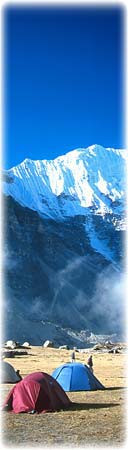
|
Miscellaneous High Altitude Animal LifeLammergeyers, like their surroundings, are breathtaking. They are the largest bird of prey in Asia, reaching up to 3 meter (10 foot) wingspans. They are also called bearded vultures or griffins because of feathers drooping from its beak resembling a mustache. At close range they dominate any valley. It is both magnificent and artful as it drafts along a ridge in a two tiered "rear guard" formation with its mate or sweeps motionlessly down valley, gone before you know it. Within the Himalayan context, though, they are like sparrows among giants. We see blue sheep often. They're gray with a blue-ish tint, in groups of 15 to 30 on incredibly steep slopes. They are remarkably fast given the difficulty of the terrain, bounding over near-vertical ground seemingly without effort or thought. We'd occasionally notice them on the hill sides above the trail we were on. Higher up they are nearer to the trail. They start moving off as soon as they notice us. Someone said it takes about 100 blue sheep to maintain one snow leopard. We never see one but folks were pretty convinced that some of the tracks on the hillsides we see are snow leopard. Given the severity of the environment, that animal must be a fabulous beast. Tuesday, November 2ndThe "A" Team/"6,900" crew and Lhonak Glacier/Tibetan pass team assemble their gear. Gary, seeming on the verge of death the night before from cold/altitude combo, is feeling great today. Everyone is having fun getting ready for the trail. I'm sorry not to be part of the adventures but delighted to be taking a road less traveled. I have 4 hikes in mind and the idea of not having to move camp daily is very appealing. It is to be 5 days before seeing them again. Didier is woefully under-equipped: no plastic boots, gaiters, lousy sleeping bag, etc. Jamie had not checked his gear in Kathmandu as Didier had been trekking in Nepal last spring. While the "A" Team is pulling out around 11:00, I start up the hill behind camp at a leisurely pace. In rising a thousand or so feet I get different breathtaking views of Kanchenjunga, Wedge Peak, Nepal Peak and Nepal Gap. This is the pass the first German mountaineers had come through from Tibet to climb Kanchenjunga in the '40's (!?). I am now looking more directly up the mountain. The 3 or 4 ice falls on north face are stunning cliffs of blue ice, formed by compressing snow fields above, then rock cliffs above that. Then more layers of ice, then snow, then rock, and so on. It's like a massive layer cake. Cameras really can not take in such masses, only small pieces of it. Wide angles get it in, but distort it. The afternoon clouds come up the western valley on schedule, rising up over the 7,000 meter peaks in front of me, changing moment by moment in an incredible kaleidoscope of wispy, feathered and featured forms racing over the two tallest peaks in my view. There are 6 or more seriously high peaks in the Kanchenjunga massive. Truly awesome. To take it all in is like "seeing" the Grand Canyon or the ocean. You can really only see one small part of it at a time. I return to camp after a delightful hike: great views, warm sun, comfortable sitting rocks, a bit of exercise. Soon after returning, Pasang shows up. He's immediately greeted with smiles and sweet Nepali milk tea. Apparently, the 6,900 Team's pressure cooker is not adequate. At high altitudes pressure cookers are mandatory. He's to return tomorrow with another. I'm the only remaining member in the communal tent. Drinking Nepali milk tea and rum, I watch as a porter, just returned from supplying the 6,900 meter group's Camp I, puts his feet in near boiling water to rejuvenate. He's been in icy, soaked canvas sneakers for a 6 hour round trip load haul in wet-to-freezing snow and ice, not complaining, just talking with his peers, feet wrinkled and white from hours of soaking. The porters are smiling, even if still in pain. They get into socks and sandals after their foot bath. I hit the tent early. Wednesday, November 3rdOn Pangpema's exposed plateau the sun hits my tent around 7, which is terrific and having a whole tent to myself is a wonderful bit of luxury. Bed tea and washing water (accompanied by sunshine: very important) becomes a joy once again. Even hot water in the freezing shade looses its appeal as it's inevitably a net heat loss. Breakfast is porridge, cereal, fried eggs, Marmite and Tibetan bread, an unleavened pita-like bread, but with Nepali character. I start today's hike at 8:30 and go up the ridge to the west of yesterday's, toward a gradually sloping, very climbable 6,000 meter peak. When looking up I didn't notice a huge canyon between camp and the final summit ridge and, now realizing this, I decide to cross the canyon. There is a broad wall of seracs, huge ice blocks, at the end of the canyon created by massive snow falls on those peaks and there is a small ice lake at the bottom of the drainage. It is a gorgeous little niche that reminds me some of Colorado, save the different scope and how user un-friendly this is compared to home. Knowing how Colorado's mountains change in character with the seasons I can see how those changes here are all the more severe. I make it across to the ascending ridge over snow-rock fields, moving slowly, as advised by Ram Kaji. It is the only way to travel in this primitive, isolated, remote, inaccessible, cathedral of spiky peaks. Even the heavily traveled trails are not for the faint of heart, particularly in snow. I reach camp at 4:15 and Ram Kaji greets me beaming "Hello, Sir. How are you?", handing me tea and crackers. We agree on dinner at 6:00. How delightful! Effortless. Early in my solo days at Pangpema I try to get Ram Kaji to call me "Dana", but the effort fails. I talk with some German trekkers, write bit in the cook tent on a bench set aside for me, with a view watching the sunset down valley. There is again the afternoon cloud rolling up valley from the lowlands with cloud-filtered setting sunlight that then dissolves into a clear, cold, starry night. Writing, I sip hot tea and rum and listen to the Nepalis chatter and play cards. Later I chat with Pasang about his experiences, particularly the recent South Korean expedition climbing and avalanche disasters. Pasang's limited English trails easily off into Nepali. Ram Kaji's English is good but is used sparingly as it comes with some effort. The cook tent is sleeping quarters after both members' and Nepalis' dinners are cleaned up. There is also a porters' overnight shelter under a huge boulder on a snowy slope a third mile from camp. It's under a 70 feet tall rock block, 50 feet on each of 4 sides. There's a cave underneath an overhang under one corner of the block, with a slightly built up entrance. Fires warm the place to some extent, depending on what fuel might have been brought in. Dinner tonight is yak mo-mo's: steamed dumplings filled with grilled yak meat, served with a spicy vegetable sauce, fried potatoes and a sparingly used Sagarmatha Brand Hot Green Chili Sauce (a special treat) . It's good and quite a delicacy in this environment. The afternoon clouds are back lit by sunset, the peaks and fangs silhouetted in blue-gray mists. I listen to Dawa, 3 kitchen boys and Ram Kaji chatter away, with Radio Kathmandu and squeaky Nepali music on and the cook stoves hissing. It was an absolutely delightful, delicious experience. Dinner finished off with a drink they called "rakshi" that Dawa said had coffee, butter and sugar but I saw a beer go into it and it tasted much more alcoholic than that. After a few sips I know I'll never get it down, so I leave my cup politely in front of me. After my huge feast I take up writing again and after a while realize the Nepalis are now into some sort of story time. Chief cook Dawa, 2 kitchen boys, and sirdar Ram Kaji listen attentively to a 3rd kitchen boy, seated on a stool in the midst of the group, deliver a non-stop monologue of some sort. People sit around looking up, asking questions every now and then. There are answers, then continued monologue. Long stretches of Radio Kathmandu talk programming in the background are broken by extended Indian or Nepali music, rhythmic, screechy women singing, repeating seemingly the same round of song over and over. When they see me watching I'm asked if I want more "rakshi" and I say "No, thank you." And the story teller's monologue continues on. Thursday, November 4thI left home 4 weeks ago. The beard is gray and ugly. My down sleeping bag sheds feathers like confetti over everything in the tent. It's another gorgeous crystalline day starting with "bed tea", Nepali style with milk and sugar. Washing water comes a minute later. There's frost on the ground that melts quickly in the sun. Today is probably summit day for the "A" Team/6,900 Group. I wish them well, knowing of those "high" hopes. Today's hike is up valley toward the "A" Team's Camp I. I move along the glacial moraine to the juncture where the main, north flowing Kanchenjunga glacier hits the opposite valley wall and turns 90° west. It is joined here by Pyramid Glacier and the West Langpo Glacier that have just merged themselves a mile up valley. The glacier is like the force of 1,000 trains colliding silently in still life, with nearly constant sounds of minor rock slides and mini avalanches. The sun is dazzling and the going is terribly slow with all the snow and uncertain snow/ice/rock footing. I turn the corner going north toward their Camp I, often loosing the trail over rock, occasionally falling through the snow to air below. This is "Nepali level": virtually all up and down. I find a comfortable lunch rock and watch the mini-glacier creep down the massive rock face across the valley. I think I must be near Camp I but I don't need to get there. When rested half to sleep in the sun, I turn and head down valley to camp. After 45 minutes I see something from the corner of my eye up valley. It's a backpacker coming my way. Gradually I realize it's Didier. When he reaches me I learn they are not summiting today. Minutes into the Camp II to Camp III climb Didier was turned back by soaking leather boots, at Jamie's suggestion and his own good sense. His makeshift gaiters had failed on leaving Pangpema, his boots were wet all along and this morning he'd stepped in ice water up to his shin. He was risking frostbite if he'd gone on. He is not a happy camper. The remaining team members are also disappointed at Didier's departure as that means they carry the communal gear and food he'd had. With 20 to 30 kilo (50 to 60 pound) packs at 5,000+ meters over really tough terrain, any more weight is unwelcome. We make it back to camp in deteriorating weather of the typical afternoon up-valley cloud just as it is getting dark, Didier severely disappointed. I am perfectly happy getting back to camp. The kitchen crew have tea ready and dinner early. As Didier is pawing through the duffle he'd left in camp looking for warm, dry cloths, the usual pre-dinner mess tent goings on are happening and I'm calmly seated in my usual place by the door sipping hot tea and rum. One poor kitchen boy is having a devil of a time getting one of the knee-high camp stoves going. The flame isn't igniting in the proper jetted fashion and he's pumping more fuel into the burner bowl and Ram Kaji is barking directions at him in an increasingly agitated fashion and every now and then a rush of flame shoots up. The rest of the kitchen crew is in their pre-dinner motion and Dawa is busy and shouts commands at the kid and Ram Kaji is getting more and more agitated and the kid is pumping and getting more agitated and it's windy outside and blowing the tent around a bit and the flame lurches are getting larger and now they almost reach the roof of the tent and Ram Kaji is yelling Nepali louder and louder now ("Yak, yak, yak...TENT!!!!") and the kid reaches to pick up the stove with his bare hands, burns himself, drops it, grabs a towel, grabs the stove and heads toward the door of the tent with the stove belching out foot and a half flames. Like a football running back, he reverse shoulder dodges past Didier and his gear which are square in the middle of the floor blocking the door. Two more running strides and he makes it to the partially open door and then, just as he's making it through the door, trips on a door flap and goes hurtling out into the black of the night, flames, wind and all. The stove goes flying, rolling to the far end of the courtyard. Kid rolls as he hits the ground. Flame goes on, sputters and dies in the wind. You couldn't help but feel sorry for the kid. He got quite the earful for the next 5 or 10 minutes. His burned hands didn't seem that bad after a while, at least compared to the tongue lashing he got. After that, though, the incident was forgotten. They never did get that stove going that night and Ram Kaji later said those Indian-made stoves just aren't very good. Friday, November 5thI have a couple lengthy conversations with Ram Kaji in the mornings. He's 44 and has been trekking business for 20 years and has worked his way up from porter to kitchen boy to cook to sirdar. He enjoys trekking but feels he's getting old for it. He's one of the more valued sirdars on Suman's staff. He has a wife with her family home near Pokhara. The winters are very cold there and so they spend winters at a place they have in the Kathmandu valley, which is pleasant in winter and convenient for school for his kids, 12, 14, and 16. They speak, read and write English in class and are comfortable with it, but for him it's not so easy. We talk of the internet. This trek/expedition we're on was made possible through the internet. The conversation was welcome and well received. Yesterday we talked of Nepal's problems: lack of resources, government corruption and ineffectualness, lack of industry save tourism, being a small land locked country in between Asian super-giants India and China with warring Pakistan next door. No easy solutions. Ram Kaji's got a perennial smile and a cheerful, genuine "How are you, sir?" attitude. He has orchestrated all the complex logistical and staff problems of the trek with aplomb, a good man indeed. I'm off for a 5 hour hike on the Kanchenjunga Glacier toward the big mountain's Camp I, first finding the trail, then loosing it, then finding it. Just getting onto the glacier is my goal. I've no thoughts of reaching Camp I. I descend moraine terraces to plateaus to rock slides to plateaus to the next terrace. As I get down to the glacier it reminds me of a white water river or a channeled ocean wave seascape frozen in time and place, with small and huge boulders sprinkled on it like confetti. As glaciers converge from 2 drainages, the dominant one makes the turn and the other crash into it, being absorbed after the impact, all in still life. There's still 2 to 4 feet of snow left. I sit mid-glacier for a while having lunch looking up at Kanchenjunga. On my way back to camp I'm startled by a "Hallo!" and see a Sherpa coming down from Camp I with a huge load of Korean gear. He has at least 70 pounds on. "Trail's down here, not there.", he tells me in so many words and, sure enough, it looks like a trail, now that he's on it. "You not have Sherpa?", he asks. "No", I tell him. I fall in behind him and do my best to keep up. 5 or 10 minutes later he's out of sight and I'm back to looking for the trail again. When I get back to camp, Pasang's there saying the "A" Team's stove failed and so they were essentially out of food and water. They are calling the climb off and will be back in Pangpema soon. "Soon" was hours later, dragging in right at dark in a chilling cloud, exhausted and severely disappointed. They hadn't even reached the base of the mountain before turning back. The severe cold was a factor, but as their one stove failed they were essentially out of food and water. It is a severe disappointment for these fellows. That night Didier has a foot bath for the 2 blue toe nail's he developed. We have yak and dhal bhaat for dinner. The Sherpas taking care of the Korean gear decide now is the time to burn the Korean trash and so there's a variety of kerosene fires around camp. Ram Kaji says that burning trash is not good for the weather and is quite serious about it. Everyone crashes early. Saturday, November. 6thThe "A" Team is exhausted and disappointed. Jamie is now going to be short on time to get in any other peak. Planning on getting down to Lhonak, we spend the morning packing. Lunch in the sunshine raised the group's spirits a bit. A Japanese group came yesterday and pitched their members' 2 tents immediately next to mine. That gave them convenient access to my group's members' toilet tent, which they felt free to use as if it were their own, without asking. They stayed up late last night talking fairly loudly, as if drinking, in the tent right next to me. I resorted to a 2nd half tab of Diamox. These were elderly serious amateur photographers who'd come, at least in part, specifically to photograph Wedge Peak. They came with photocopies and specifications of a professional photographer's work, leaving their tripoded cameras fixed on Wedge Peak throughout much of the day, waiting for the right moment. Wedge Peak is a gorgeous pointy spade shaped, fluted snow wall that towers above camp immediately across the valley. Jamie says it's one of those gorgeous peaks that really should not be climbed. Apparently one Japanese group climbed it from another side. This photographer's problem, I thought, is that, although a gorgeous face, there isn't much sun on a north facing slope in November. Having seen how proud the elderly gent was of his preparedness with the photocopies and specs, I ask him as best I can in what month the professional had taken his shot. After finally getting through, he looks and realizes that the pro's shot was done in May. Then he realizes why I'd asked. The sun's much higher in the sky in late spring. In November it was so low the north face gets little, if any, direct sun. Now realizing, he smiles excitedly at me, squinting in the sun, tapping his temple. He'd probably already taken the best shot he is going to get this trip. I wait around to socialize a bit and then left with the crowd. The porters are anxious to leave for Lhonak as the hike down is a tough one and we are now using up our sunshine hours talking. I arrive late in the afternoon and Dave and Joel are there as well. They'd not made it far up the glacier, about half as much as they'd hoped, the conditions being rugged there as well, but they had a great time and had strong support staff. As dinner gets under way, Pasang hands out some Chinese "brandy" that none of the 8 of us can really stomach. Jamie and Joel find a bottle of Bagpiper Whiskey at the store, one of India's finest, according to the label. It makes several rounds around the dinner table. It's better in food (soup, hot fruit salad and milk) than by itself. Yak mo-mo's with more Sagarmatha Green Chili are a definite hit. A number of us go over to the local guest house/store/lodge. Joel and Sam are bopping to some English retro music. The girls taking care of the place for their families are from Gyabla but say they're from Ghunsa, being a much bigger town. Dancing starts. I bug out and hit the tent. Sunday, November 7hThe Korean porter brigade that had been up at Pangpema collecting the last of the gear to be hauled out came down to Lhonak yesterday too. They are up at 6 and stampede down valley at 7 with all sorts of noise and commotion. Bed tea is served shortly thereafter. Crawling out of my single tent (a luxury!) around 7:30, I'm the first one of our group to emerge. 3 American women camped 70 feet away are watching as I do, looking suitably disheveled with feathers all over me. We chat amiably. They're from San Diego and Seattle. After much packing, breakfast and stuff, we bid our last adieu to Lhonak and head down. Going down it is a dramatically different landscape than we'd seen coming up. Much snow has melted and the valley floor has emerged since we first arrived. The trek down valley holds much awe, a bit of sadness for leaving, and much relief from the snow. We meet a large herd of yaks being driven up the trail and for 45 minutes we let these beasts pass by. When they see us they usually leave the trail and scatter themselves across a huge steep hillside above us. The herdsman, seen early on, vanishes. We encounter another 5 unit yak team carrying construction lumber (a sign of encroaching civilization) being driven across the top of a steep landslide area while we are on the trail below, probably to avoid rocks rolling down on the animals. We pass several "absolute jewel" quality waterfalls, hundreds of feet tall. The walk down to Khambachen is long and we're exhausted. We have a late lunch around 3 overlooking town to allow the porters to catch up. Dave twists an ankle badly just before making it to lunch. He'll now be limping for days. After dinner children dance for us for a few rupees as we watch from the dining tent. We talk about some of us taking the longer South Kanchenjunga Base Camp loop after Ghunsa. The "A" Team isn't going to be taking the plane out of Taplejung on the 15th but rather will be continuing the trek for another 40 days, going north into the Makalu area, over some incredible pass, into the Everest area, and then to fly out of Lukla back to Kathmandu before Christmas. Jannu towers over us again and there are bushes and a couple trees on the valley's slopes. It's truly good to get back down to the land of the living. Monday, November 8hRest day in Khambachen. Breakfast ends with hot nak milk and an auction/garage sale of Dave's extra gear he will no longer need: high altitude and cold weather stuff the Makalu/Everest guys covet for their continuing adventures. I let some heavy hiking socks go to Sam and Joel who are hurting for socks and will need them more than I will. Played with the kids for a while. They love frisbee and the hands-between-the-legs-flipping-the-feet-over-the-head trick. That could go on forever. Sun leaves camp site at 3. We'll split up into 2 groups tomorrow after Ghunsa, the "A" Team going into the south base camp. It will be Jamie, Dave, Didier and myself flying as planned: Taplejung - Biratnagar - Kathmandu. We'll be there a week from today, theoretically. Tuesday, November 9hKhambachen to Ghunsa. The smell of cedar fires this morning in Khambachen is wonderful, smoke seeping through the roofs of virtually every building in town. Each day down brings us into "new" environments, new for a number of reasons. The trail always looks different going the other way and, without the snow and rain we had on the way in, it's a different world. We hike into and through different cedar forests, then other kinds of pines, each in their own thermocline, eventually into deciduous trees. It's like coming down to earth. Ghunsa has partying going on for some festival. Dancing Nepalis beckon us from a porch to join them. I decline and move on to our rest stop, the Ghunsa Guest House. We had camped in the back yard coming through the first time and now we decide to take bunks inside. What a feeling: our first night indoors since Biratnagar! We have beers and tungbas down the street at a tea house before dinner. School children are part of the festival and are to give us a show after our dinner. It's a fundraiser orchestrated by their Brahman teachers. The Brahmans are a low land sect or caste that apparently are more fluent in Nepali than most and tend to take teaching positions. They seem dictatorial, self-serving and arrogant. After dinner the kids are waiting patiently, laughing and joking with themselves in the bitter cold. One lead teacher starts in on a dragging "poor us" speech. Tenzing, our climbing Sherpa, pipes up in the middle of this and angrily tells the guy to get on with it, that the kids are sitting there freezing, which gets a round of applause from the crowd. They then start the children's song and dance presentation which is absolutely charming. The plate is passed lead by our Sherpa Pasang who artfully arranges the bills, some candies and a handful of pens I still had. There are short speeches and then the teachers dance, which is an annoying distraction. There is a mass distribution of candies to the kids by Jamie, creating a mild hysteria panic, a cake Dawa had cooked for us, a slight ruckus with a drunk Nepali, and somewhat restful evening in close indoor quarters with a few un-named snorers. Dave, who'd endured my snoring for most of the trip, "plead the 5th" when asked if I did. Wednesday, November 10thGhunsa to Gyabla. We find that our plans are wrong and the "A" Team will not have the time and/or staff to do the south base camp route, so they will be staying with us to Taplejung. It's so great to be going downhill. New thermoclines. I buy some Tibetan Sherpa aprons at Phale. It's a gorgeous walk in perfect weather however a lot of up hill walking for going "down" valley, (rising to get over cliffs, etc.). Lunch is cooked riverside and features a passing yak train. It is bitter cold when we arrive in Gyabla where we again camp on the soccer field. Tenzing is there again throwing up tents and then, when a frisbee is lost over a cliff underneath an outhouse, retrieves it. Didier sleeps out without a tent, perhaps to avoid my snoring. Thursday, November 11thGyabla to Amjilosa to Sekatum (2 days' up hiking in one down). Dave's bum ankle causes him to leave early to get a jump on this long day. I leave next at 7:30am and the 2 of us stay ahead of the pack all day. It's wonderful not have to 'leapfrog' with the porters. It's a gorgeous hike through bamboo, steep canyon walls and high grassy hillsides with late summer breezes. Absolutely delightful. Passing things we hadn't seen in the rain, we are now able to see the whole valley, as if for the first time. Trail intersections are confusing and, with no one in sight fore or aft, a bit iffy. There are lizards. Dave sees turkeys. We reach Sekatum at 2:30pm. We have beers and conversation with a Dutch group in Sekathum. Rinse out some cloths. There's a brief Mothers' Committee tea and song/dance, and passing of the plate. Quiet dinner. Martin enthralled with "The Death Zone", Joel subdued, some pervasive disappointment with the foiled climbing plans. I'm delighted with the whole experience. Friday, November 12thJamie's recommendations for next treks: Manaslu circuit, Annapurna circuit, Ladakh (In India, he says it's like Tibet, but without the Chinese. Needs 3½ weeks.) Nepali rafting is highly recommended for its intense days and kick-back evenings. Recommended outfitters: Wet Dreams is #1; Equator Expeditions; Adrift Nepal; and Himalayan Encounters). We walk down through cardamom groves down to the river and have lunch at the quaint village of Tapletoc. Just downhill from Tapletoc we pass the route we'd come down from the temple on and so the rest of the trek is new to us. We camp in a beautiful wheat field just up hill from Chirwa. Cute kids. French trekking group offer Didier conversation. Asleep by 7:30. Saturday, November 13thMinutes after setting off, we go through the quaint, cute, cramped town of Chirwa, wedged in between huge boulders. Here we briefly encounter a train of porters with 40 kilo (80 to 90 pound) burlap bags filled with the cardamom harvest just now on the way to market in Taplejung. An incredible smell. Each bag brings in 15,000 rupees ($225). As we move higher, such as to cross over top of a cliff, the river roar subsides and there are absolutely magnificent forest sounds of saccades and exotic forest birds. We move over and under cliff faces, occasionally coming to a crest overlooking vast expanses of terraced valleys and forests. We lunch at Lingkam (1,720 meters; 5,642 feet), heading toward Phorumbu tonight. We have a long uphill trudge most of the afternoon and camp at 4:30 in a school yard on a ridge. There are 11 beers in the town and we buy them out. I have one. Animated dinner conversation again: fun examining a praying mantis, congenial laughter. Gary's feeling better from his severely bleeding nose, lack of energy, etc. We all are feeling better. In bed at 7:30. Sunday, November 14thCurious villagers come hanging around camp shortly after dawn, negating privacy. Our porters, recruited from the Taplejung area, apparently several spent upwards of a 2 hours hiking home last night, but are back again around 7. There's discussion of priorities once in Kathmandu (pizza? cold beer? Ice cream?). Each to his own. Yesterday we saw the Taplejung airstrip ridge from a distance. Today we walk there. I can't believe we're almost at the end of our road. A monastery. Several villages. Children along the way are now consistently asking for pens. We walk through Taplejung past many buildings we never saw on our way in. The village is just downhill from the airstrip and we'd walked the other way. We finally get to the guest house we're to stay in and make ourselves at home at some tables near the bar. It seems as fashionable and civilized as the French Riviera. I'm taken by a Tibetan rug thrown down on the bunks and decide to buy it from the gorgeous inn keeper Sherpa woman, Cheeling Lamor. We watch the parting gift ceremony of a German couple and their porters. It brings a few snickers at the seeming feigned gratitude, paltry gift-tips, and staged-camaraderie good-bye photos. To our great amusement, Dawa rounds up as many chickens as he can in a flurry of feathers for what becomes a wonderful last night's dinner of curried chicken. There is a hat passed for porters' and cook staff tips. The Germans next door have some musicians and dancers and I join in that for a bit and then crash shortly thereafter. I miss and mostly sleep through a lot of our group's dancing and continued merriment downstairs. Monday, November 15thThe beer consumption from last night is a phenomenal 77 bottles, although the Sherpas and some porters had helped create that. The tipping ceremony for the staff is heartfelt and touching. A row of porters and staff faces a row of members. Jamie talks in Nepali for a while. When he finishes we applaud one another with enthusiasm, whoops and cheers. Then each is called in turn to step forward for his share. Then the two lines pass each other with many handshakes, smiles and hugs. They're given 3 or 4 day's pay tip for 32 days work and I think are sincerely grateful. The porters who'd left the trek earlier on had been tipped proportionally. Some porters stay to see the plane off. Others walk home. It was a successful trek for all. A Japanese jeep pulls up to the guesthouse, the first vehicle I'd seen in 32 days. Our excess gear goes on this truck overland to Biratnagar and then flies to Kathmandu with Pasang. We wander toward the airstrip and Cheeling comes out and drapes white flowing scarves over the necks of the departing and walks back to her guesthouse. The twin otter is first heard, then seen approaching the airstrip. It lands and stops using half the airstrip. We say our goodbyes and good luck to the "A" Team and wish them wonderful adventures, sorry, in part, we aren't to be with them. Dave's and my rugs don't make the plane. The hour's flight to Biratnagar is again thrilling with a few shots of the big peaks to the north. After a couple hours' wait in that airport we take another twin otter to Kathmandu. Jeetendra is there again to collect us, bless him. I get dropped off to see if I can get an earlier flight and the rest go out for pizza. It is strangely good to be back in this mad house city. In my hotel room for only 20 minutes, Miss Elizabeth Hawley calls, regretting that it's too late to come by today and tomorrow there is to be a transportation strike. When I assure her the climb data is a straight forward tale to tell, we settle on a phone call in the morning. Tuesday, November 16thRight on schedule, Miss Hawley calls promptly at 9. I give her the details of our expedition (who was at what camp, at what altitude, when, who summited when and when they left the mountain, etc.). I then ask of previous climbs of Tengkoma. There are 2. There was one 1949 Swiss expedition which was training for Kanchenjunga. She leaves the phone to see if she has the records of that climb, but comes back after 5 or so minutes to say she regrets she doesn't. Last year, '98, there was an American group that climbed it and she knows precisely who was on that. The route they used was the one we did. I ask her was if there was anyone over 50 on it and without looking at her records she said "Not even close." At any rate, I'm the oldest person to climb Tengkoma in the last 50 years, during my lifetime. Final DaysI had booked my flights based on an early version of the trip itinerary which later had been changed, so I spent 4 reasonably uneventful days in Kathmandu: a slide show of the Annapurna circuit, dinners with friends, walks around some of the more "authentic" sections of the city, shopping. There may have been an option to take in a quick river raft trip and the amenities Dynasty Hotel were too attractive and so I spent time reading and taking in the experience. The trip home was a reasonably uneventful retracing of the way out. An exception was a wonderful view of Mt. Fuji rising like a perfect conical pile of sand above the clouds in bright blue skies. There was a relatively painless lugging of my 2 huge bags the airline had tagged "Extra Heavy". Last ThoughtsIt was an absolutely fabulous "peak" experience. I can not recommend it or something like it highly enough to anyone even vaguely interested. These are spectacular, lovely, remote places and people yet relatively untouched, and certainly unmoved, by today's civilization. There is a joy - and a gratitude - I gained for being alive and being there. I have a much greater confidence for going again. Writing up my notes and reviewing the pictures brings most of it back. Within days of arriving in the States, suffering from jet lag and the beginnings of a month long bout with a flu/bronchitis, I half woke hearing that elusive music I'd heard in those mountains: eerie, cheerful, clangy, sing-song, repetitive, foreign. The tapes are still there in my mind, although their immediacy isn't. The images, feelings, sounds are with me even though I'm now back in another "real" world. I am so utterly delighted and thankful I saw that one, that very real world. I want to, and believe I will, go back, hopefully to trek in and climb some other modest peak, while I still can. If you want to, and can, absolutely do so. [And he did return the following year] |
|

|
Namaste! Namaste! 

jdesign -- all rights reserved -- frozen in time July 2013 |