
 |
Our treks | Expeditions | Contact us | About us | Old photos & Diaries |


|
Controversy on Cho OyuThe guide to getting up selected commercial operator's noses Background: Cho Oyu, 8201m, is the sixth highest mountain on the planet and considered one of the easiest 8000m mountains to climb. Jamie summitted 26 Sept 99. He was climbing without Sherpa support and alone, well, as alone as you can be with 10 other expeditions at the same time, and was the only person climbing in this style. It was a fine and sunny day, not a cloud in the sky, not too hot, the sort perfect for a picnic, if you had down suit on and champagne that doesn't freeze, that is. But Douglas Adams admirers, Hitchcock and Stephen King fans would have noticed something amiss, just that faint uneasiness, that tight gut feeling that sets your alarm bells ringing, because there was a cloud in the sky, only one, just a small one, and it was sitting exactly on the very top of Cho Oyu. It was a controversy cloud, although the climber failed to notice this. For by listening carefully it probably would have buzzed and crackled with haunting sounds, and if Jamie had looked carefully the words controversy in wavy pink and purple shades were probably floating around. But being an unbeliever, he was content to enjoy the solitude and the lack of views on the summit. The beginningI'm not sure how it all began, but here I was in a bus full of Koreans on my way to the Chinese border, officially the expedition leader and unofficially simply a Cho Oyu hitch hiker. The team of nine Koreans had booked with us and we had expected two other groups to join so my role was to manage the logistics of the expeditions so that everyone was happy. At the last minute two of the teams postponed so here I was more or less without a job. Well, I hardly claim to work for a living so this suited me. I also hardly claim to be a climber so Cho Oyu also suited me, or so I naively thought. I had met Henry Todd, who organizes climbing trips to Cho Oyu, Everest and Ama Dablam, and a few other climbers, and all said that Cho Oyu was a walk and no more. It was mentioned that there is one place where a rope is usually fixed and that was about it. In the event, there was perhaps 700m or more of fixed rope on the mountain, although much of that was unnecessary in good conditions. Also, being an 8000m mountain, it is big - obviously. But it is only once you start setting up camps that you realise just HOW BIG it is. And also although it is considered a relatively safe, relatively means relatively. It is a lot scarier than the 6000m mountains I was accustomed to and I was glad to have lots of other expeditions around. (In fact I had "attempted" Cho Oyu once before, completely solo, but I never climbed above the lake; that is another story though). So, I found myself on a real expedition and it was a real challenge for me, just what I needed. Indeed getting to the mountain was the first challenge, and even though you can drive to the base camp this severely underestimates the difficulty. We only just managed to cross several treacherous landslides and this resulted in an unplanned stay in the border town Zhangmu. At least the bureaucracy, in the capable hands of Explore Himalaya on the Nepal side and our China-Tibet Mountaineering Association guide in Tibet, was as smooth as silk. Not content just to let nature take a swipe at them, the next day it became obvious the Koreans wanted to have a good try at their equivalent of hara-kiri by ignoring even the most basic acclimatization procedures. It was their intention simply to arrive in base camp as quickly as possible and despite entreaties by myself, the sherpas and the Tibetan guide, they still did not appreciate the fact that staying one night at 2400m then one at 3900m then to 4800m the next day often has rapidly fatal consequences. Eventually we persuaded them by trickery and logic to spend an extra night at Nyalam and two intermediate nights at Tingri at 4200m but it was during this episode that I had my first lesson about why so many Asian expeditions get such a bad reputation so quickly, for what the leader says must be obeyed without question. To have a foreigner, guide and sherpas sticking their noses in was not appreciated, and basically ignored under the pretence of language difficulties, hence he buggered off to base camp a day earlier from Tingri. We of course has the last laugh because the sherpas are more used to big altitude jumps and I had recently returned from high altitude Ladakh. So, while we expressed an appreciation for life in general the Koreans spend most of their time holding their heads and taking ineffective herbal remedies. The leader ended up spending a whole week recovering at Tingri and 5 other members had to descend from Advanced Base Camp (ABC) to base camp for a couple of days. Base campSo the first adventure is getting to base camp, the second is getting to ABC for when the road runs out the yaks take over. And yaks require yak drivers. In the Everest region of Nepal these are youngsters who, while sometimes arrogant, understand some English and what honesty is. In Tibet they are ruffian brigands straight from the last century, or the millennia before that. It was surreal wandering behind them essentially invisible. Their unnatural whoops, yelps and cries encouraged the yaks to keep moving while they chatting with the sherpas in guttural grunts that couldn't possibly be a language. For them little has changed, the loads may be barrels and kitbags (75-90kgs per yak), not salt to be traded for rice, but with their hair coiled Khampa-style around their head, sheepskin jackets, knives in their belt and grime accumulated since childhood, they are as authentic as they come. Yak hair tents, yak dung fires, salt tea, tsampa (ground roasted barley) and legs of dried sheep, and of course those magnificently proud yaks. Even if owners don't always look like their dogs, Tibetans are all like their yaks.When the loads were unceremoniously dumped at ABC that is where Tibet ended and the climbing circus began. Amazingly nothing was missing, one good aspect of Chinese rule, and whereas in the past Tibetans had frequently raided the camps I don't think there was a single theft incident anywhere for anyone. But this was no longer Tibet, instead there was a colourful tent city strewn among the rubble at 5600m and gaudy aliens wandering about speaking a multitude of languages. There were four large commercial expeditions, a few smaller ones and a few semi-national teams and me. And everyone climbed the mountain by the same method, except me. This involved spending a few days at ABC then taking a day trip to Camp 1 (C1: 6400m) then a day or two later returning to stay the night. Then a few days later another run to C1 would result in a day trip to C2 (7100m) with two nights at C1 then back to ABC to recover, then up again in stages cumulating in an overnight at C2, then from ABC hopefully a few of the clients/climbers would be capable of summitting from their first night at C3, 7500m. Meanwhile the sherpas should have set up all the camps and stocked them with the necessities. In contrast I spent a week staying at ABC ferrying up supplies to Lake Camp (Camp 1/2, since it is half way to Camp 1) then this became my ABC as I set up C1, and from there I didn't return down, instead setting up C2 from there. Whilst in the middle of this a commercial guide helpfully pointed out the fatal flaw in my method, and that is it is assumed that above 6000m people basically can't recover and simply deteriorate over time. Well, I was having no problems; I ate like a mountaineer, slept without waking and generally felt perfect despite not having descended below 6000m for 10 days. In fact, I felt physically ready to go to for the summit by the time I was comfy in Camp 2 but the dirty tricks came out and Russell Brice of Himalayan Experience spread a rumour that a storm was coming so, after a debate with some Slovakian climbers, we decided to head down. This was probably a wise move anyway, since the mountain wasn't ready for us but why did he do this? Unbeknown to me there had been considerable debate in ABC about the conditions. Henry Todd, manager of an expedition with perhaps 15 members, Eric Simonson of International Mountain Guides (USA) with around 18 members, Russell Brice with only 2 climbing members and Jim Litch of Adventure Consultants (New Zealand) with 12 members felt that conditions on the mountain were unusual and potentially very dangerous. They were particularly concerned with the slopes above C3, which looked ready to avalanche, and avalanches are often set off by climbers making "tear along the dotted line" trails thru the danger areas. These fears were very reasonable and already partially proved because the first team to attempt the summit, French guide Marc Batard with client Anna Collet and two sherpas had taken a non-standard route to avoid the area of concern and still two of them were swept 100m down in an avalanche they set off. Rather hair-raising even if nobody was hurt. Then Russell had set off with sherpas from Henry and Eric to fix the ropes above C3 and they hadn't been able to get much higher than C3 due to deep snow. So Russell, Henry and Eric had decided to pull their clients out, and just to make sure nobody summitted and made them look bad, and to get their clients down without argument, there was a storm warning. Was it really fake? Russell could tell you, but won't, but the other expeditions with satellite weather forecasts didn't draw the same conclusion. AvalancheI toyed with the idea of staying up at C2 through it because I only half-believed the forecast but I would have looked uncommonly foolish if there was a real storm because I had already ignored conditions at my peril. Earlier I had set off from C1 heading to C2 for the first time and in fine conditions when more than half way up it started to snow. Afternoon showers were common, but this was a bit heavier. I had a few choices, pitch camp where I was, return to C1 or head to C2, which the sherpas had assured me, was safe from avalanches. Since I was moving fast, I elected to keep going up, a mistake because the snow was accumulating quickly and was already mid-calf deep. Becoming more and more nervous, I reached a crux point, should I turn back, or should I keep going, surely I must be close to C2? Just then I felt the fixed rope move. "Going up or coming down?" I yelled through the thick flakes. The reply was not what I expected, "Get off the bloody rope out of my way, avalanche coming your way soon. I can see the crack forming." And sure enough, just as I had unclipped from the rope and moved around behind a serac there was a whoosh and powder swirled around my waist. I was hanging onto the fixed rope so tightly, arm awkwardly fully outstretched to the taut rope, that I don't remember if there was any force behind it or not. But where Chris was, unsheltered, he thought it was going to break his legs as it swirled past neck deep. At that point the fixed rope had been set too tightly so he had little room to manoeuvre and that is why he had yelled for me to get off it, so that he might dash around under the serac where I was. There was an awful silence then Brad, his partner who was standing just above the crack line, began yelling, sure that Chris had been swept to his death. I could see Chris now and yelled back he was OK, but this confused him because he didn't know about me, Brad still wanted to hear his voice. Chris still couldn't catch his breath. Immediately we got the hell out of there, me back to C1 while Chris and Brad (two American mountain guides without clients) returned to ABC. They set the avalanche down on me, but if I had ascended that same stretch, I would have triggered it myself. And since I was alive and unhurt, I was happy with the way it panned. As it turned out, they were evacuating C2 because was no longer safe from avalanches. Obviously I should have turned back well before I did, and indeed I had had a rather close call. Should have trusted that gut feeling earlier. |
|


|
Back upOnly slightly deterred, the next day I set off again for C2, but well after lots of other people. At the top of the first serac, a little over half way, I was horrified to look at what I had been climbing blind through the snowfall. God, I was silly! I took a careful look at it now and decided that I might be wiser camping where I was and climbing the next stretch the to C2 early the following day, it looked so dangerous. So just as I had set up camp, Russell and the team of sherpas steamed past to C2, heedless of my concerns. Up to that point, I had had a good opinion of Russell but that began to blow it. He took 10 sherpas onto a slope that was patently still delicate, especially since the sun had hammered it all day thickening and potentially destabilising the snow, and part of it had actually avalanched (so that bit might be OK, but the rest didn't look good). I had also learnt that Henry was an unsavoury type. Since right from the beginning of the expedition he had refused to speak to me and refused to even acknowledge that I existed, which was really quite funny since I gave some of his clients a polite helping hand and advice. This must have needled him considerably because we had to pass going the opposite ways on a fixed rope on a tricky section. Once past me he gave me a quick glance to check that I was still clipped on and as I was about to unclip to change ropes, he yanked the rope suddenly and violently with the pretence of passing his client. Bastard from hell and convicted acid dealer, he is. I was in a precarious position on an almost vertical ice wall on my front points and the only reason I didn't fall awkwardly was I had a finger thru the ring of an ice screw. I wouldn't have fallen to my death - he had checked that I was still clipped on - but the incident was payback for my niceness. Eric wasn't a nasty person but he kept his expedition team on tight rein and minimised socialising. The most you could get out of him was a few words but Chris and Brad had digs at him all the time, drawing him in to traps: "Eric, is it true you don't allow fraternisation on your expeditions", and Eric would bite. "Yes, because -", and too late, Chris would nail him "what the boss ain't getting, you ain't" getting." Jim from Adventure Consultants seemed by far the most sensible of the big commercial group guides, and they ran the tightest expedition too, with two doctors and two more western climbing guides. He didn't feel the least bit threatened by me because Adventure Consultant clients are not the sort of people who want to save a few dollars and go with a local operator. So these guys had been discussing how to deal with the difficult conditions on the upper mountain and that brings me back to the storm warning: if I stayed up at C2 after a storm rumour and there was a big dump of snow, I would deservedly be dead or the laughing stock of ABC. I arrived at ABC to a grossly distorted story of the avalanche and to the fact that Eric, Henry and Russell had called for yaks and were abandoning the climb. Adventure consultants were going to wait, which seemed the most sensible course. But Russell's storm warning ploy had at least cleared the mountain and made it easier for other expeditions to abandon hope by getting everyone together at ABC as the big debate raged. The rumours swirled. I had no doubts and indeed was staying at Lake Camp, only returning to ABC for the day. To the summitThe Koreans had invited me to climb with them to the summit in a few days, for their benefit rather than mine, together with three Japanese and of course their two sherpas and the two sherpas of the Koreans. While they laboured up to C2, I rested in C1 with minor food poisoning. So the next day I climbed directly to C3, my first time there. I had planned to carry my fly (the outside part of a tent: I didn't take the inner to save weight at C2) and stove etc up from C2 but using another team's radio Pasang said they would make room for me in a tent. When I arrived the berth was a few inches of floor squeezed in with three others, so four of us in a 3-person tent. Instead, I elected to sleep outside. At midnight I realised I had chosen the wrong spot since everyone was gathered on this dining table-sized flat spot ready for the summit attempt, and all were wearing crampons and there I was lying on the ground in a down sleeping bag that didn't want any extra holes in it. I am not an early starter and in fact for most summit climbs, as most mornings trekking, I don't get out of my sleeping bag until the sun hits. Having always succeeded when climbing alone I had planned a similar start, or rather I hadn't planned anything, but thought that everyone was bound to be so slow that if I started when I woke up at sunrise, that would be OK. And it would have been, except that I was in immediate danger of becoming a pincushion, so I set off first with Pasang. 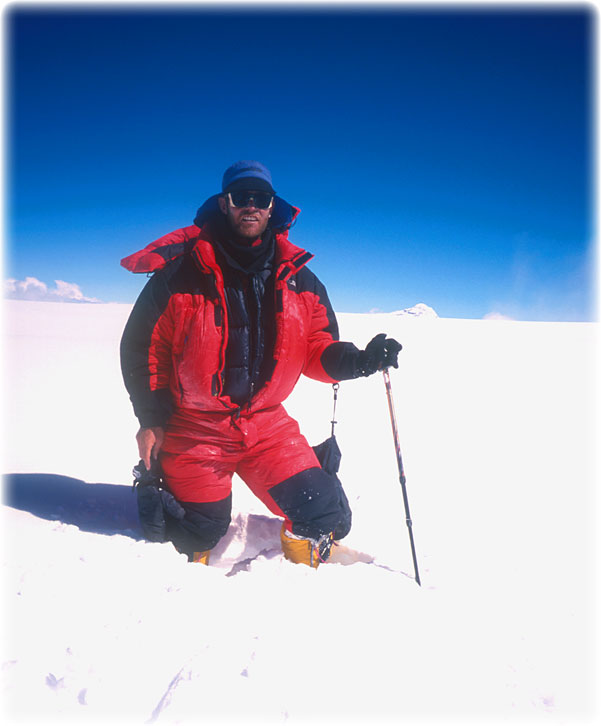
The previous day Gombu and Pasang had broken trail in the deep snow and fixed some ropes, but higher up more rope was required so I belayed Pasang while he did this. It was slow going but in a borrowed down suit (thanks Michael - a friend who has climbed on several 8000m mountains) with a down jacket underneath and with the warmest boots in the world on (One Sport Everest's), the severe night cold didn't worry me, and with a bright full moon I never even used my head torch. We stopped several times to look at the snow conditions because according to everyone at ABC we were walking into the barrel of a loaded gun, or in our case, a slope ready to avalanche. Many friends had offered their opinions, opinions more expert than mine, but the bottom line was everybody was making these judgments without having been close to the slope (a rather wise idea if it may be about to fall on top of you, perhaps). Once there, I did many tests and found that the soft snow, around waist deep, simply got denser the deeper you probed. There were no obvious layers and to me it didn't seem particularly dangerous. All the same, I broke trail much more than my fair share so that I was at the top of the line of people. Helpfully, friends had carefully described the route to me and despite my entreaties to Pasang, he had taken a different line. He couldn't explain why but his judgment was sound for the less steep normal route at that point did in fact avalanche several days later. Also, nobody was interested in moving in a diagonal line so as to minimise the number of climbers an avalanche might hit, nor did anyone seem interested in keeping a good distance apart. So the slope was properly tested. Further up the angle eased but the snow was still thigh deep and often waist deep and the Koreans and Japanese faded, no longer capable of breaking trail for more than a metre or two, if at all. The sherpas of the Japanese were finished too; they had been carrying 30kg loads up the mountain every single day, demonstrating astonishing endurance, but this selfless work had caught up with them. One of them was using oxygen that a Japanese girl didn't want to use and was still finding it tough going. Pasang and Gombu were also tiring as they had spent considerable time fixing the ropes at 7600m the day before. So it was yours truly who kept pushing on up. I also had a secret weapon, or rather, it wasn't secret, but nobody else had it, and that was some pure carbohydrate powder. On the advice of Michael, I had managed to find (in a grim sports store in Delhi, of all places) some body builders' protein powder and carbo powder. I had used a healthy portion of the protein powder almost every evening once on the mountain (including a dinner the night before of three portions) and would load my water bottle up with the carb stuff when climbing between camps. A power bar or Clif bar and the like have a little over 100 calories each; I had perhaps 1500 calories or more of this tasteless powder mixed in with pomelo-flavoured Tang in a litre bottle, and I had another 3 litres of water in a bag around my waist. So while almost everybody's water had frozen, mine, stored in the down suit, was drinkable and I still had an appetite, devouring Mars bars and other chocolate and biscuits. I was still going strong, even 14 hours later when I finally approached the summit. The other climbers were strewn in the snow behind while I plodded through the now knee-deep snow of the summit plateau. Most climbers had headed to a point where they could see Everest but I was determined to get to the real summit, only something like 20 metres higher, but perhaps 1/2 a kilometre away. After two false summits I approached the third and that is when I was engulfed by the only cloud on the mountain, indeed I think it was the only cloud in the sky. I failed to notice it was a controversy cloud. I saw Everest barely long enough to register it and after my last Mars bar headed down to where the Koreans were taking photos, and just as I arrived there the cloud blocked my view again. Still further back the Japanese were lolling in the snow. DownAlthough everyone was tired, the descent took perhaps only 3 hours to camp 3 and I descended back to Camp 2. Waiting here was the delighted Patrick, Brad and Chris ready for a summit attempt the following day. Originally Brad and Chris had planned to climb another route but conditions were far from perfect and Patrick was cutting it fine since the day after the yaks were leaving ABC, so he had a single day to climb the mountain and return to ABC. So they were particularly pleased that the trail had been broken, especially because they wanted to climb from Camp 2 rather than make another at Camp 3. They set off well before midnight. The next morning feeling jubilant and relaxed, I hung around Camp 2 enjoying the view and leisurely packing my stuff and waiting for the boys to return. They did, after successfully summitting, mid-afternoon. All were ecstatic but shattered, but wanted to keep heading down the mountain, so I set off with them. Among the carry-on they teased me, relating that they had got to my high point and were surprised to find that I hadn't quite reached the real summit. I was perhaps 2 or 3 vertical metres off and somewhere around 50 horizontal metres. "As good as there," they said as I related how this cloud had messed up my summit views. The controversy cloud. Further down Patrick finally accepted some assistance and I carried a small portion of his gear and walked into Henry's camp with Patrick. There were congratulations all-round, although Henry was absent. And it was probably a good time to be absent since here was one of his team successful yet all the others weren't being given the chance to stay and have a go themselves. Neither could Russell's clients or Eric Simonson's. This struck me as being strange. Sure, they had ordered the yaks and would have to pay for them even if they postponed their departure, but even if it cost $5000 extra to do this, with clients that had EACH paid between $10000 and $18000, and there were over 30 clients, this was not an exorbitant amount of money to correct a judgment error. But no, they bailed as planned. KathmanduI arrived back in Kathmandu to the news that I had not really summitted. Now this was true, and I didn't particularly care, but what amused me was that nobody mentioned the Koreans and Japanese, and they hadn't even attempted to cross the summit plateau to the real summit. Nope, the commercial operator's ire was directed solely towards me. I should have realised that I would get the sour grapes "blame" for opening up the trail. Russell managed to make an idiot of himself in front of several well-known climbers by accusing me of "knowing nothing, nothing." I agree, I know little of 8000m peak craft, but that is stretching the truth about Nepal and Tibet in general since I have summitted quite a number of 6000m peaks and have more than 50 treks and expeditions to my name and speak Nepali. Some people cover their mistakes in strange ways. So how did Adventure Consultants do? Although the majority of their team returned early the guides and two clients stayed on, summitting perhaps a week or so after I did. Also a few Slovenians and some French also summitted but overall around 10% of the mountaineers on the mountain succeeded that season, much less than the usual third or so. A few of you may know that I was planning to attempt Cho Oyu and Shishapangma. Due to the less than ideal conditions the Cho Oyu climb took much more time than l had allowed for so I didn't have enough time to summit Shishapangma and return to Kathmandu for the next group. I toyed with the idea of only going to Camp 1 just to get a feel for the mountain and I seriously considered staying on Cho Oyu to climb it once more (yep, I felt in top condition) but logistically this was difficult since I was listed as the leader and so had to leave with the Korean team. 
jdesign -- all rights reserved -- frozen in time July 2013 |