Detailed itinerary
We plan to follow the itinerary however roads wash
out, or are extended, occasionally people get sick, logistical challenges arise,
or we hear of a better campsite, and so
we will adapt it as needed.
(Day 0 - arrive Delhi / early Leh arrival)
We spend three nights in Leh, so reasonable acclimatization to the
3480m/11,415ft altitude but if you are new
to altitude or to Leh, perhaps plan to arrive one day early and we will
arrange transfers plus hotel and show you around. In particular for this trek, we suggest people from North America arrive a day early as the flights are arduous and the time zone change large.
Included in all our Ladakh trips are a couple of sightseeing trips, with or
without a cultural guide (your choice) and it is your choice of where to go;
many people joining us are previous trekkers so have seen some places previously.
If you are more ambitious we can also arrange a day or overnight trip
to Alchi (~3100m) and Basgo Gompas or further afield Lamayuru (~3500m), a day rafting trip on the Zanskar River or hammer down the Khardung La on a mountain bike (best a few days into your Leh
sojourn). If you have several days, we recommend a Nubra jeep safari or overnighting at Panggong Lake. The cost for all of these adventures are reasonable, and paid directly to the drivers in Leh.
If you have been working flat out you are welcome to just relax, kick
back and de-stress too.
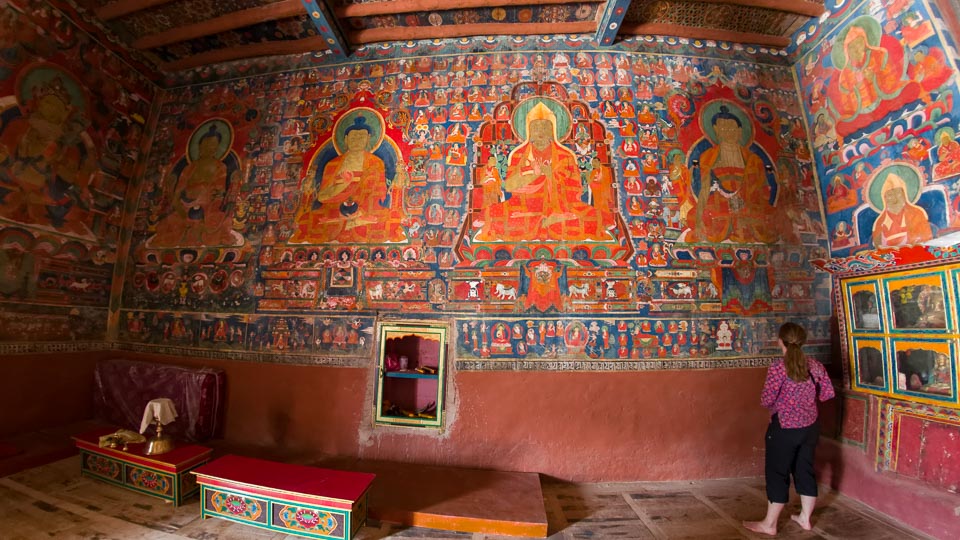
Sophie admires the mural at Basgo - Jamie
Day 1 - meet in Leh 3480m
Phew, after a long series of flights, you are here! Look for a Project Himalaya sign or a simple sign with your
name on it at the airport, and our wonderful drivers Ang Chuk or Pasang will pick you up.
Jamie meets you at the hotel on your arrival and we discuss altitude health (and the time zone change for North Americans) over
tea/coffee or breakfast then introduce Leh and show you the better places
to eat. Most people crash out for a few hours and spend the day relaxing and recovering. Do drink
plenty of fluids, which helps the acclimatization process, and do also pop some multi-vitamins to help in a small way to ward off colds from the plane or being rundown from the travel.
We normally go out to
dinner together; let's meet in the peaceful hotel garden by 6:30pm, arrive earlier to soak in the view. We eat at some of our favourite clean (very important!) restaurants: Wonderland, Chopsticks, Bon Appetit, Open Hand, G Kitchen, Tibet Kitchen and Summer Harvest.
2 - Leh 3480m
This is a day for experiencing the revered gompas, monasteries and palaces of the Indus Valley, ie a short drive from Leh. We arrange a jeep or two (and a local
culture guide if you like, included). Usually, we arrange as a morning trip with a late lunch out of Leh then
you can relax in the afternoon although we can easily arrange a full day trip as an alternative.
Choosing what to see is the biggest
challenge, there are so many special places to visit. Close by are Spituk Gompa and Stok Palace. To the east is Shey Palace, and the gompas Thikse, Hemis, Chemde, Thagthok, Stakna and Matho, although don't plan on visiting all of them in one day. Thikse also has a good restaurant for lunch.
Heading west out of Leh are Spituk, Phyang, Nyemo where the Indus meets the Zanskar River, and further afield are Basgo, Likir and Alchi.
Visiting a gompa is atmospheric and a timeless experience engendering respect for their philosophy.

We chanced upon this moving ceremony at Matho Gompa - Jamie
3 - Leh 3480m
After gentle sightseeing yesterday we exercise a little more today. In the morning we might wander up to the palace and gompa above Leh, and before dinner, perhaps up to the Peace/Shanti Stupa for a Leh
sunset panorama.
Because tomorrow we stay at ~4000m, at minimum we need three nights here in Leh prior to moving
higher.
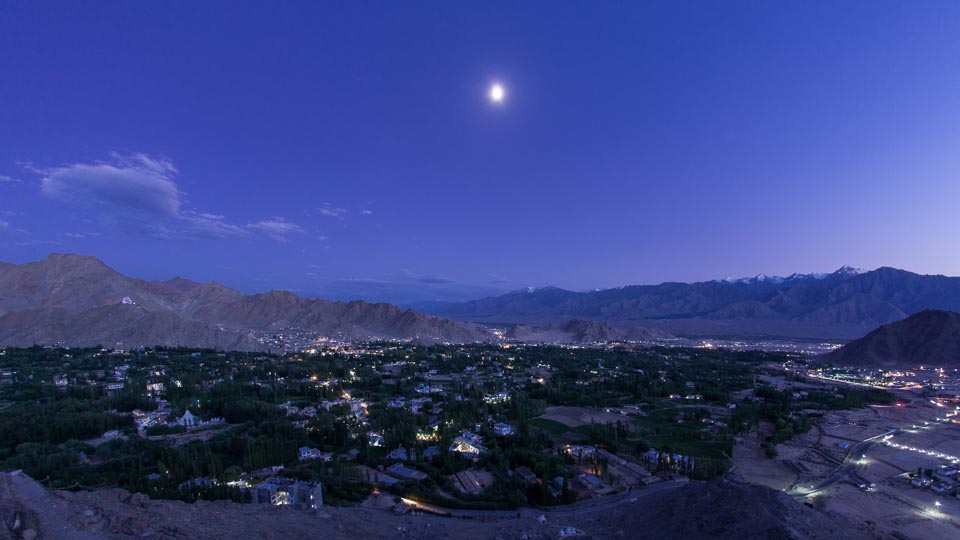
Leh from Shanti Stupa - Jamie
4 - drive Lhatoo 4000m with sightseeing
At last we are on our way. It is only a couple of hours drive so we will stop at a gompa or two en route. Once at our camp, there are amazing views of the rugged canyon walls just a few minutes walk away.

Lunch laid out, come and get it - Jamie
5 - drive Gatta Loops, trek Tsometsik / Marang La junction 4100m
Our horses are waiting for us and once we are loaded up we trek a few hours along the river to leave the road behind and get into true wilderness. We are following the Tsarap Chu, a river well known to us both in its upper reaches, and also where it meets the Zanskar, doubling the volume and turning into a fearsome river.
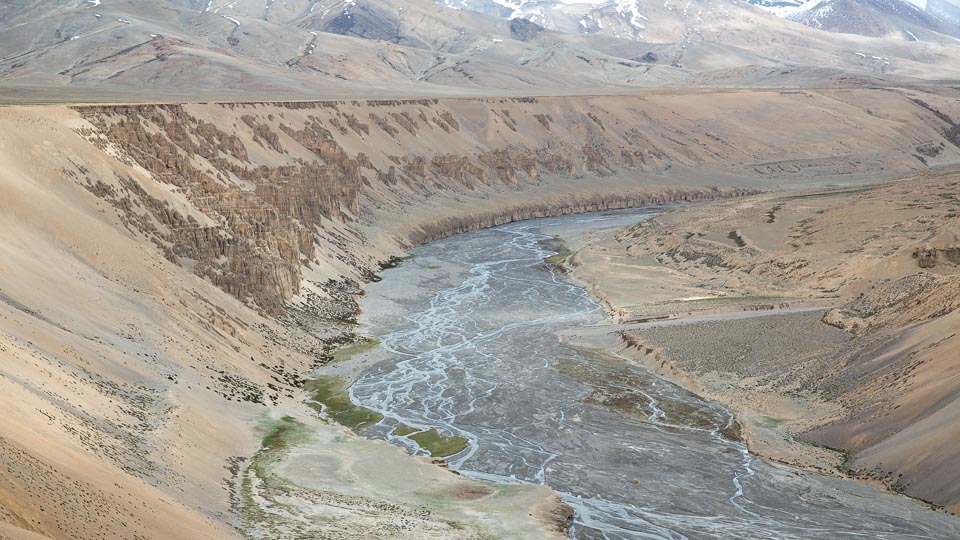
Magnificent scenery and a view of one of our favorite camps on another area, taken from the road - Jamie
6 - trek Tichhip 4000m
7 - trek Normoche 4000m via Zara Chu crossing
8 - trek Trantrag 4100m

Have you ever seen water this crystal-clear? - Jamie
9 - trek Shade 4220m
Another glorious day's trekking.

A truly captivating scene in real life - Jamie
10 - rest Shade 4220m
This is one of the remotest villages in Ladakh. In 2013 we asked the locals how many
trekkers come through in a season, the first answer was "lots". However asking
further, lots meant perhaps five groups, of which Project Himalaya is usually one ...
Do watch the sheep-goat flocks being herded in during the early evening. Often they come right through our camp, so you will get some warning.
Sadly most of the younger people have left this village, a lack of opportunity and especially a lack of healthcare.

Remote, peaceful Shade village - Jamie
11 - trek stream camp 4280m via Rotang La 4900m, Lar La 4680m
Leaving Shade we take a yak herding route up a side valley, climbing to a pass with ever more expansive views behind us. Over the first pass we normally meet Shade families camped in yak hair tents tending the animals, which are kept out of the village area when there are crops in the fields. Tea in a tent?
Continuing, we drop down to cross the stream and climb again for the second pass of the day, perhaps having a lunch break part way up. We are treated to more stunning panoramas at the top, and thankfully it isn't too far down to our camp by the sparkling stream.
12 - trek Yarinchun 4430m
This is a remote area but there is still a definite trail with never-ending views of the "flame" rocks opposite. We have some steam crossings ahead, carry your river sandals, and don't dawdle too much as the streams rise in the later afternoon. Camp is gorgeous as usual.

13 - trek Zangla Sumdo 3850m
It is another sandals day, although not initially. Leaving camp, the ascent is gentle at first but becomes a steady climb to the top of the Pandang La, 5150m, the highest pass on our trek. The extensive views are glorious, especially out towards the Chacha La and Jumlam route. the price though, after an initial straightforward descent to our lunch spot,
is increasing steep areas and crossings of the steam amid the willows. Great care is required in one section; Lobsang should assess/check out the landslide area first.

14 - trek Zangla camp 3600m
It feels refreshingly remote and simply refreshing too, as we cross the stream repeatedly, making our way down the valley. At a main river junction we see signs of shepherd camps again but don't be lulled by this or the relatively flat nature of the small trail so far.
Now we descend into another adventurous and forbidding but photogenic gorge with perhaps 15 stream crossings before the terrain eases.

Suddenly the valley opens out as we are close to the village of Zangla, only a ridge to traverse up and around to the ridge top palace-gompa. Suddenly we see the huge main Zanskar valley, dotted with small villages surrounded by fields. We drop down to camp on a grassy area near the main Zanskar river, that like everything else in the valley,
is a bit bigger; wider and faster too, that we are accustomed to. By now it is apparent why we take our side route through Shade, and just what an amazing and adventurous route it is.
15 - trek Honara / Zanskar sightseeing 3600m
The crew will resupply, perhaps taking a jeep in to Padum, and we can trek or take a jeep to the next camp, the location of which will depend on our route choice ahead. If by jeep, then it is partly a rest day.

16 - trek Bear Valley camp 3980m
Assuming you are up for more adventure, following is a quick description of the "Bear Valley" route. However the first decision point about this route is the bears. In the past they have not been aggressive however in the last couple of years close to Dibling, they have acquired a taste for mules and cows, and so Lobsang will seek local advice as to what is best for our team.
The second is can we get through? This is an adventurous route that can be blocked, although we do aim for this route as a preference.
The alternative is the standard Zanskar trek, initially hot trekking to Nyete but as with everywhere here, the character of the land changes higher up, as ever the panoramas are gorgeous,
and even more so from the top of the Hanuma La 4710m, overlooking Lingshed. This area is justly famous trekking,
even if the coming road has changed the trekking character, but really has added to the convenience of the gompa and village.
As of 2015 the road head was still above Yelchung so still a day's walk from Lingshed and will probably stay that way for a couple more years. Once it reaches Lingshed, I am guessing it will become a major destination for the overnight tripper from Leh.
For Bear Valley we were camped in the main Zanskar Valley and now exit, which means a surprisingly steep climb,
but the distraction is the abundant Himalayan rose bushes and the remote feeling.
The climb may have been steep but the Namtse La at 4430m isn't too high, and our descent to camp is gentle and quick. This is what we call Bear Valley, for want of finding a better name, and have indeed seen bears here, and signs of them when we didn't actually run into them on the trail.

Our delightful "Bear Valley" campsite - Jamie
17 - trek Lankat camp
We camp at the last possible place before the pass so that tomorrow's distance is manageable. It is a rock hoodoo camp.

18 - Trek Nyerog / Nyeraks 3710m
A tough but rewarding day today. We ascend with the panoramas growing ever more grand, to the top of the Nerak La (Tarti La; 5000m) and to the breath-taking panoramas. We traverse and ascend to the surprisingly rarely visited yet delightful village of Nyerog.


Neraks, a wonderful camp - Jamie
19 - trek Yelchung 3900m / road head camp
Between us and the Sengge La is the mighty Zanskar River, and the descent is not too far down, crossing it on a seemingly flimsy bridge that has been there for decades - let's see if this bridge was the one that did survive, if it hasn't it will have been rebuilt.
The climb is another matter, steady and relatively steep until cresting a small pass to the last village we pass through.
Yulchung is still one of the best-kept secrets of the Lingshed area, a delightfully friendly and stunningly set village that few trekkers ever visit,
despite being only a little off one of the main trekking routes.

Having tea, Yelchung - Jamie
20 - drive Leh
Sadly our trekking has come to an end as we hop into our waiting jeeps for the approximately 6 hour drive back to Leh.
The first obstacle is the 4960m Sengge La, a once remote pass that has poisonous flowers over the other side. Poisonous to horses,
but hopefully not to our jeeps. The view from the top is as stunning as any, those colours and textures. Down the pass and over a
small bump comes perhaps what was the most photographed or certainly the most admired village view in the region, Photoksar.
Again, it was a dramatic photo of this village that surely inspired not just me but dozens of trekkers, years ago.
We are not done with the passes yet, the Sirsir La at 4805m comes next, and another majestic panorama that Jaroslav Poncar snapped,
providing inspiration years ago. Instead of taking days to discover these views we take hours, and in some way lessening the achievement;
luckily by trekking through Kargyak, Phuktal and Shun Shade we have explored on foot some other utterly memorable panoramas.
Depending on how the last section of the trek has worked out, we also have the option of visiting Lamayuru Gompa on the way back, let's see how the timing is.

Stakna Gompa, with this view we know we are getting close to Leh - Jamie
Day 21 - trip end
You are free to take the morning flight to Delhi or bus to Manali for the long way back, or just enjoy more time in this central Asian town of yore.
Julley!


